Friday, July 2, 2010
David Grant on Vetpulse.tv on the issue of Status Dogs
"Status dogs are just one part of the general social problems of the inner cities."
Talk given to veterinary students at the University of Nottingham, 20th May 2010


Monday, June 28, 2010
Fly Strike!
No apologies for returning to this horrid subject, but anyone of a sensitive disposition may prefer not to follow some of the links.
Hot and humid weather is perfect for carrion-feeding flies and there are lots of them about. Unfortunately they don't only feed on rotting substances—they will just as happily lay eggs on living animals who have open wounds, sores of any kind, or wet or soiled fur/skin. Rabbits are particularly vulnerable, but any animal which is having difficulty keeping clean or has matted fur will be at risk.
Sadly the rabbit brought to us late on Saturday evening had to be put to sleep because he was too badly damaged by maggots to be saved. Fatal maggot injury can occur within hours of flies laying eggs on an animal, which is why it is so important to check "at-risk" animals twice daily.
There are more details about preventing fly strike in pets and farm animals on the national RSPCA website (not upsetting) and a truly horrible report of a suffering cat in Kent online.
If you find fly eggs or maggots on any animal it is important to contact a vet immediately. Fly attack is a particular problem for rabbits and there are special veterinary products which can be applied to prevent eggs developing into maggots. Ask your vet about this when your bunnies go in for their Spring myxomatosis boosters.
Sunday, June 27, 2010
I knew it!
More black propaganda from people who will not have to pick up the pieces if we go under.

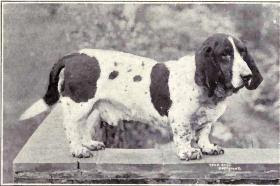
When we got the original circular from HQ asking us not to include "beauty" classes in any official RSPCA fun dog shows I must admit I was apprehensive that it could be used against us. Of course if we did run classes where "cute" appearance was the main criterion, that could be used against us too.
I'm not entirely convinced that the real problem with show dogs is judging by appearance so much as judging by distorted ideas of what is desirable appearance.

This picture is a modern Basset hound.

This is one from 1915.
The older dog is much less exaggerated and has more normal back legs and less folded facial skin. That's no guarantee that he didn't have ectropion or any of the other ills that plague some pedigree breeds, but I can't help thinking that selecting for dogs that looked more similar to him would be likely to improve the general fitness of Bassets.
I'm afraid we are seeing a pattern here.
The RSPCA is fundamentally a charity which provides services for animals (welfare law enforcement, veterinary treatment, rehoming etc.) and also campaigns on issues which affect animal welfare.
It's the services which make the campaigns credible: people with frontline experience of animal welfare work are likely to know what they're talking about and people who are putting unpaid effort into practical ways of improving animals' lives must genuinely care about animal welfare. The size and unified nature of the RSPCA probably impresses politicians with the likelihood that we're backed by substantial numbers of citizens with votes, but to some extent that's a secondary consideration.
Because of this credibility, virtually any person or organisation which wants to affect animal issues (whether to achieve change or prevent it) sees the RSPCA as a gatekeeper: government is likely to believe us if we say there really is a welfare problem, but it will also believe us if we say things are more complicated than other animal campaigners think. Many people who genuinely care about animals but have an overwhelming concern for one area, such as animal experiments, or factory farming, see us as the only thing which is stopping them from succeeding, because we're not giving unqualified support to whatever it is they want.
Add on those, like the kennel club, or foxhunters who see us as the organisation with enough clout to stop them going on doing what they like, and the result is that threats to our ability to provide the welfare services are used as blackmail to change the welfare policy. This is the, "I'll never give the RSPCA another penny and I'll tell all my friends unless you .... (abolish fox-hunting, bring back fox-hunting, say pedigree dogs are healthy, say pedigree dogs should be abolished—fill in the blank to taste)" route.
On top of this, we're never going to be able to provide the service level many of the public expect, so we have a constant background of genuine complaints plus spurious ones from people who are aware that the most effective way to strike at the RSPCA is to hit our ability as a service provider. None of this is helpful when we need to recruit volunteers to work at the fairly mundane jobs that are essential to keeping the services going.
I'm afraid we are seeing a pattern here.
The RSPCA is fundamentally a charity which provides services for animals (welfare law enforcement, veterinary treatment, rehoming etc.) and also campaigns on issues which affect animal welfare.
It's the services which make the campaigns credible: people with frontline experience of animal welfare work are likely to know what they're talking about and people who are putting unpaid effort into practical ways of improving animals' lives must genuinely care about animal welfare. The size and unified nature of the RSPCA probably impresses politicians with the likelihood that we're backed by substantial numbers of citizens with votes, but to some extent that's a secondary consideration.
Because of this credibility, virtually any person or organisation which wants to affect animal issues (whether to achieve change or prevent it) sees the RSPCA as a gatekeeper: government is likely to believe us if we say there really is a welfare problem, but it will also believe us if we say things are more complicated than other animal campaigners think. Many people who genuinely care about animals but have an overwhelming concern for one area, such as animal experiments, or factory farming, see us as the only thing which is stopping them from succeeding, because we're not giving unqualified support to whatever it is they want.
Add on those, like the kennel club, or foxhunters who see us as the organisation with enough clout to stop them going on doing what they like, and the result is that threats to our ability to provide the welfare services are used as blackmail to change the welfare policy. This is the, "I'll never give the RSPCA another penny and I'll tell all my friends unless you .... (abolish fox-hunting, bring back fox-hunting, say pedigree dogs are healthy, say pedigree dogs should be abolished—fill in the blank to taste)" route.
On top of this, we're never going to be able to provide the service level many of the public expect, so we have a constant background of genuine complaints plus spurious ones from people who are aware that the most effective way to strike at the RSPCA is to hit our ability as a service provider. None of this is helpful when we need to recruit volunteers to work at the fairly mundane jobs that are essential to keeping the services going.
Saturday, June 26, 2010
Friday, June 25, 2010
Ethan turns out to be Felix!

This shows the benefits of advertising our animals online, and also that, if you've lost an animal, one important avenue to search is local shelters' lists of animals in need of homes. Obviously you should also contact them direct, but a picture is much more easily identified than a description in words.
Anyway, nice to have a happy ending.
Monday, June 21, 2010
Rabbit open day final count

This will be put towards supporting veterinary treatment and neutering of rabbits.
As an example of what this amount can achieve, it could:
- Fund 386 subsidised vaccinations at our clinic to protect rabbits against myxomatosis.
- Allow us to provide 50 veterinary consultations for rabbits at our clinic.
- Neuter 20 male rabbits at private vets.
- Spay 10 female rabbits at private vets.
THANK YOU! to everyone who helped make the day such a success — particularly to Twigs and her partner Steve, but also to all the volunteers who baked cakes and to the local branch of dairycrest who donated cartons of milk and orange juice.
Some more pictures from the open day:
 Peaches eating some hay
Some more pictures from the open day:

Hawthorn has climbed up a ramp onto the roof of his sleeping area to keep an eye on the visitors.

Masses of roses.
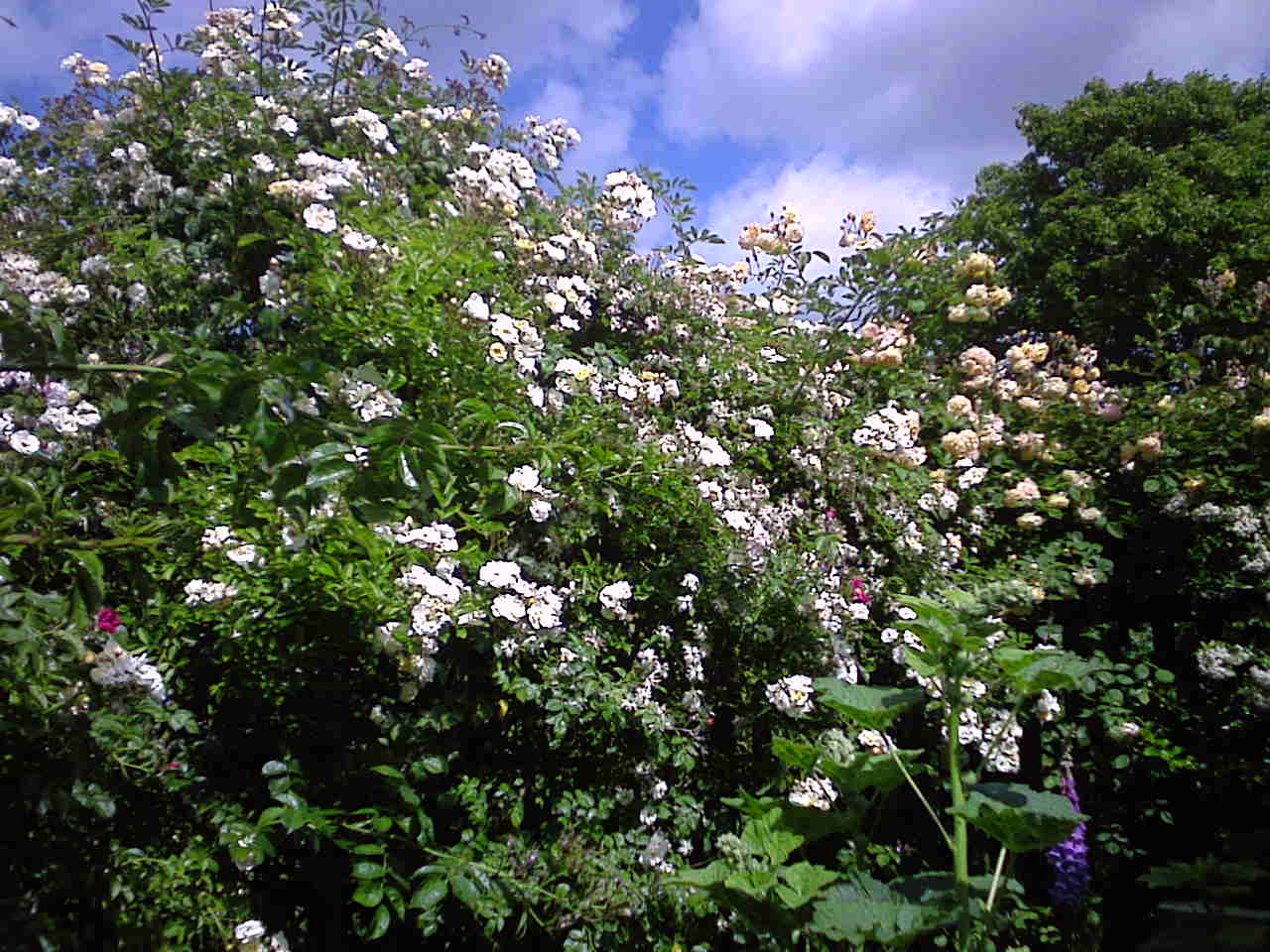
and more...

This shot gives some idea of the true size of the rabbits pens.

And here, with one of the rabbits to give a sense of scale. If you look very carefully you can see her eyes and nose are slightly scarred. This is because she had myxomatosis last year, but survived because she had been vaccinated so had a comparatively mild case of the disease. Without vaccination she would almost certainly have died.

Electric fencing to deter foxes (with unconcerned rabbit just below). The bungee is to stop the rabbits nipping through the fence with their powerful teeth when it is turned off during the daytime and they are let out. The current is not high enough to injure the fox, but just gives enough of a jolt to discourage them from climbing onto the pens and terrifying the rabbits. The pens are made from heavy-duty mesh which a predator would be unlikely to be able to tear.

Closeup of the electric strand. You can just see it running along the bungee.


Sunday, June 20, 2010
Pictures from the rabbit open day yesterday


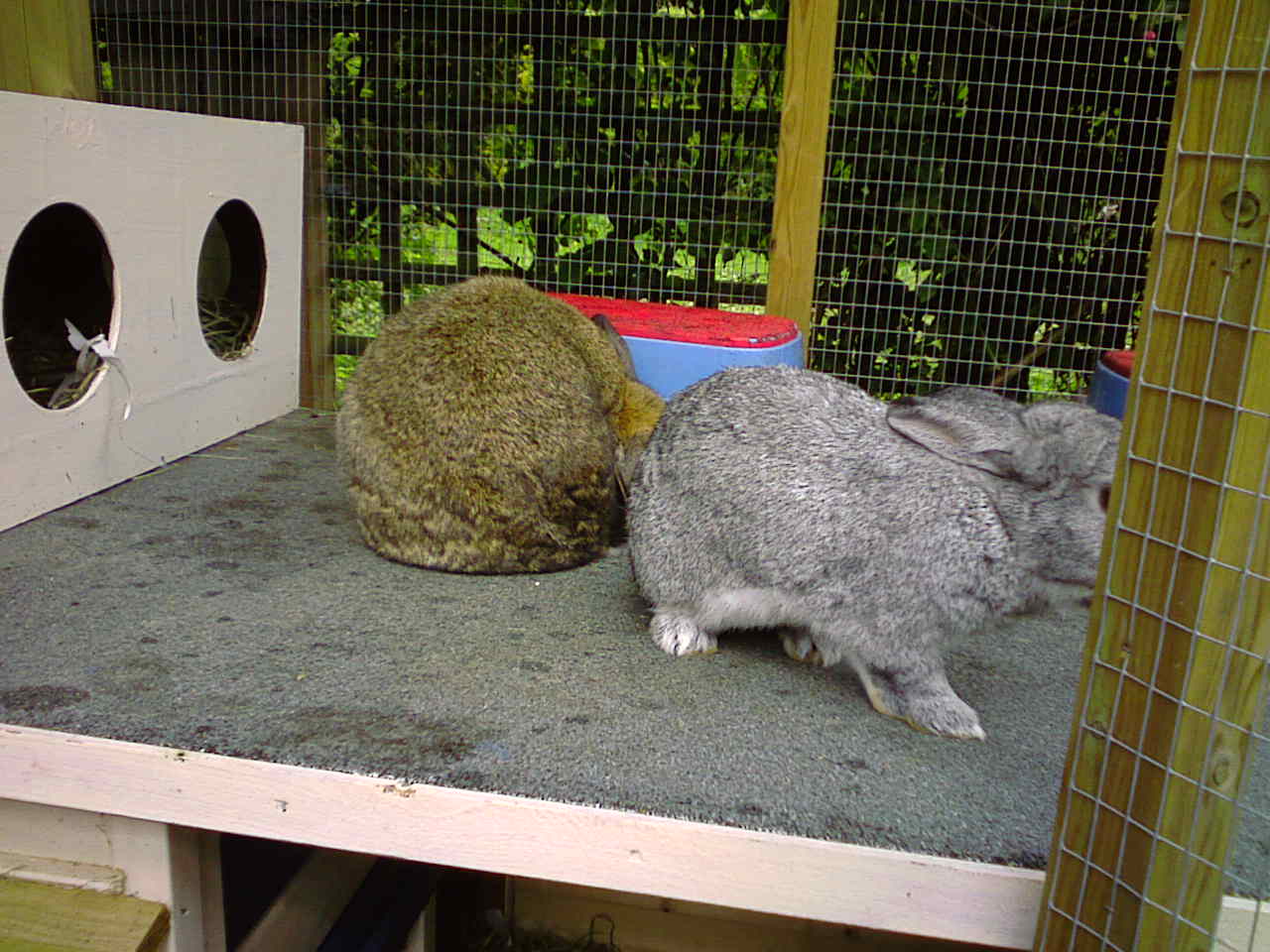

These rabbits are not up for rehoming—they are permanent residents of the garden which Twigs Way kindly opens in aid of animal welfare charities each year.
As you can see from the photos it is a fantastic educational opportunity for the children who visit (as well as lots of fun) because it shows them how much space and effort is needed to keep rabbits properly.
Even visitors who were knowledgeable about rabbits were quite surprised to see how much use they made of all the platforms and ramps inside the runs. Some of the rabbits in the pictures are actually hopping up to ledges at human eye level so that they can make contact with their visitors. The children were given suitable green foods, such as dandelions and milk thistle so they could feed the rabbits healthy treats.
Visualising big numbers
I think one of the reasons why people seem to find it hard to think rationally about the RSPCA is the sheer scale of the numbers.
The National Control Centre takes over a million calls every year.
The national RSPCA's income is just over a hundred million pounds in the same period.
That means roughly £100 is available to deal with each incident. That's just enough to spay a large-ish bitch at a fairly inexpensive vet, to keep her in boarding kennels for 20 days, or to cover the consultation fee for out of hours treatment at an emergency vet. Usually when a dog needs help urgently all three of those will be necessary.
If each call represented a request to take in an unwanted animal there is no way that could be done.
Similarly with donations; which are probably the most likely to take a hit from the "I will never give another penny to the RSPCA and I'll tell all my friends" brigade. The National Society organises door-to-door collections asking donors to set up direct debits. Proceeds from this are split 50/50 between them and the individual branches, meaning each branch gets roughly £12,000 each year—usually representing around 10% of a branch's total income.
The total amount raised by the collections is just over four million pounds—a very large amount; comparatively small once it's been spread across 174 branches, but a 10% decrease in funding would be a very big blow to a branch.
If the door-to-door fund-raising took a serious hit we'd have to make cutbacks—probably increasing the charges for treatment at our clinic and stopping help for owners who find even our subsidised rates very difficult to afford.
Our clinic treats roughly 2,000 animals each year, which probably represents around 4,000 families in Cambridge and the surrounding area who have their pets registered with our clinic at any one time. That's something like 2% of the population, and losing the clinic would mean extra financial hardship for these local people. Many, possibly most, of them would stop getting routine preventive veterinary care for their pets and just hope for the best until something catastrophic happened.
To give some perspective on the amount of money available to run the RSPCA as a 24/7 service for all of England and Wales:
The proposed NHS efficiency savings in the forthcoming budget would run the whole of the RSPCA for ten thousand years (yes - that's the figure for the savings, not their actual budget).
The Cambridge University's income from former students' donations (relatively small change from their point of view) would run the RSPCA for five thousand years. It has six times as many staff as the RSPCA.
These figures are so big that at some point most people's eyes just glaze over, but without trying to grasp them there's no way to think sensibly about the big animal charities which are providing services to the animal population.
The RSPCA saves 95% of healthy or treatable cats taken in to its shelters. It would be a tragedy if that record was destroyed by people who aren't capable of running the proverbial whelk stall.
To give some perspective on the amount of money available to run the RSPCA as a 24/7 service for all of England and Wales:
The proposed NHS efficiency savings in the forthcoming budget would run the whole of the RSPCA for ten thousand years (yes - that's the figure for the savings, not their actual budget).
The Cambridge University's income from former students' donations (relatively small change from their point of view) would run the RSPCA for five thousand years. It has six times as many staff as the RSPCA.
These figures are so big that at some point most people's eyes just glaze over, but without trying to grasp them there's no way to think sensibly about the big animal charities which are providing services to the animal population.
The RSPCA saves 95% of healthy or treatable cats taken in to its shelters. It would be a tragedy if that record was destroyed by people who aren't capable of running the proverbial whelk stall.
Saturday, June 19, 2010
AGM results and some thoughts on "governance"
A total of thirteen members attended our branch AGM yesterday, so we were comfortably quorate and everyone standing for re-election to the committee got in. However, thirteen people out of a branch membership of roughly 300 people is really not all that great, and a total membership of 300 isn't ultimately going to be enough to sustain services to 4,000-odd people long-term. Add in the wider population who expect us to be able to help with wildlife casualties, injured strays and so on, and it's just impossibly top-heavy.
The RSPCA is a very democratic charity—if you want to get rid of me, you can vote me out—but it depends on people being willing to participate, put in some work to achieve our goals and accept that majority decisions must be final. The idea of working within a structure of rules puts some people off because they think it's "bureaucratic" but without rules to decide who can make decisions and when a decision has been made the result would be chaos and nothing would ever get settled.
To participate in the decision-making processes of the RSPCA the first requirement is to become a member. Anyone with a genuine desire to help animals may join, although application from someone who wanted to use their membership for an ulterior purpose might be rejected (for example someone who joined in order to reverse the Society's policies against battery farming would have their application refused).
Three months after joining a member is entitled to receive voting papers for National Society elections and to attend their local branch AGM and vote in the election of the branch committee. They are also entitled to stand for election to their branch committee, but are not eligible to stand for election to the National Society's ruling council until they have been members for at least five years.
Branch elections do sometimes result in policy changes (although a lot of the time just getting enough people elected to form a committee is a struggle). Thirty years ago this branch did no rehoming at all, and this was only changed when a group of new people were elected to the committee. What happened wasn't exactly like a parliamentary election as members of both the old group and the new group were elected at the AGM (creating a much larger committee than before), but the new group formed a majority and put through the policy change. This kind of sudden shift is comparatively unusual and most of the time committees gain just a few new individuals each year.
This poses a problem in itself because new members are essential if committees aren't to wind up composed entirely of octogenarians, but being the only person who doesn't understand what's going on can make newly elected members feel the rest are forming a clique to exclude them. If you join a branch, be patient, and don't expect to understand everything immediately. Branches are complicated organisations, handling substantial amounts of money and requiring a lot of sustained work to keep them going. If you join in and help with existing activities you'll find it all gradually falls into place (and you'll have a wonderful command of acronyms—NCC, IET, RTA, RHQ—just like everyone else!)
Friday, June 18, 2010
Thursday, June 17, 2010

Wednesday, June 16, 2010
That Channel 4 programme
Grim shop meeting this evening at 188 Mill Road. It's now long enough since the Channel 4 anti-RSPCA "documentary" to assess some of its impact and donations have been hit significantly. At least one commercial house-clearance agent who regularly gave the shop old books it was too much trouble for him to sell has stopped because he now believes we've got plenty of money and aren't spending it on the animals. The antique centre round the corner in Gwydir st is apparently telling customers not to give to the RSPCA: "because they've got loads of money and don't care about animals".
I'm sure the Channel 4 programme makers thought they were very daring and anti-establishment—it would be daring and anti-establishment to cut NHS funding (after all it's got a million times as much cash as the RSPCA) and just let sick people die, but that wouldn't make it a good idea.
Ironically Dogs Today this month is featuring the Animals Count party as "the political party that wants an NHS for dogs". It would be more useful if they hadn't done their level best to destroy the closest thing to an animals' NHS that exists, although I respect Beverley Cuddy for being willing to allow honest discussion in the comments of her articles.
Tuesday, June 15, 2010
Reminder: Branch AGM this Thursday
Just a reminder that the branch AGM is this Thursday, 17th June at the Friends Meeting House, Jesus Lane, Cambridge. Meeting starts at 7.30 pm. Anyone interested in the RSPCA is very welcome to attend, but only adult members of the Society can vote in the election of the committee.
If you are a member, please do try to attend as we need to have enough qualified voting members present for a valid election.
Map below. There is parking close to the hall in the multi-story car park nearby in Park Street.
View Larger Map
Monday, June 14, 2010
Better to light a candle than curse the darkness...
But it is b. annoying when someone is trying to knock the matches out of your hand.
It is truly terrifying that this was apparently written by a fairly senior politician.
He says:
It is truly terrifying that this was apparently written by a fairly senior politician.
He says:
"Now I gather the RSPCA like other animal welfare charities receives no government funding which makes this policy change even more bizarre"
Why is it bizarre that the RSPCA needs to make choices about which animals are in greatest need because we depend on donations and fundraising instead of being able to raise income from taxes?
He says:
"we have had both cats and dogs from their branch at Radcliffe on Trent - and was never happy that they only housed animals for 7 days before putting them to sleep, but now to just shut their doors is shameful."
If he had looked at the Radcliffe's website he would have seen that many of the animals advertised for rehoming had been in their care for many months and the "only 7 days" claim is just not true. If he had bothered to read the main RSPCA website he would have seen that the RSPCA is not "shutting its doors"; we are giving the most needy animals priority so that they are guaranteed a safe place.
He seems incapable of understanding that reducing donations to the RSPCA will mean fewer animals can be helped and he has no idea that the Radcliffe home is run by volunteers, or indeed what a very large part of the RSPCA is run by volunteer trustees who are permanently worried about raising funds to carry on. Judging from his Twitter feed he doesn't see any reason at all why someone like me should be upset—after all I am only a volunteer. He doesn't appear to know or care about the very low-income families who use RSPCA clinics and hospitals for their pets.
It's the irresponsible, campaign mentality that's so terrifying. He really does think all he needs to do is to put enough pressure on us and we'll magically do everything he wants out of a bottomless pit of funds. I don't think it much matters which political party is in power—only that the people at the top should have experience of running something productive themselves, not predominantly campaigning.
Branch animal welfare statistics so far this year
Rehomed: 13 dogs, 23 cats, 4 rabbits and 6 miscellaneous animals.
Veterinary treatments given: 1,110 dogs, 505 cats 46 rabbits and 26 miscellaneous animals.
67 dogs and 57 cats neutered, 44 dogs and 52 cats microchipped.
Veterinary treatments given: 1,110 dogs, 505 cats 46 rabbits and 26 miscellaneous animals.
67 dogs and 57 cats neutered, 44 dogs and 52 cats microchipped.
Sunday, June 13, 2010
Spitting tacks!
Why do people who can't afford any veterinary treatment choose to keep big dogs and breed from them without making any effort to find out beforehand whether any help is going to be available if things go wrong?
Yesterday our clinic had a phone call from an owner saying his dog couldn't stand up and he wanted one of our vets to go out to see her. The reception staff on duty persuaded him to find someone who could bring her to the clinic and fortunately he managed this before the duty vets were due to leave. It turned out that she had mastitis and high fever, which hopefully can be treated with antibiotics, but if he'd left it any later she'd very probably have died. We don't know the status of her puppies.
It's one thing if an animal has an expensive accident out of the blue, but to breed a bitch knowing that you can't afford to take her to a vet in normal surgery hours if she gets an infection and not make any effort to find out whether there is an RSPCA or PDSA clinic locally, or how to go about registering there, really takes the biscuit.
Saturday, June 12, 2010
Re-homing widget
If you click the "get widget" button, you can share the widget on facebook, myspace etc. If you have accounts on any of these, please share it, so that our most recent pics of animals looking for homes are shown as widely as possible. Thank you in anticipation.
Thursday, June 10, 2010
Screening prospective adopters
There's a lot of argument about how far rescue organisations should go in screening potential animal adopters. On the one hand, it's possible that good homes might be lost if the procedure drives away prospective adopters who feel it's too intrusive or if the criteria are too rigid. On the other there are a few people who are not "abusive" but who simply will not go along with reasonable safety instructions (such as keeping a new cat indoors for long enough to ensure bonding to a new house, or not letting dogs out in the street alone).
Arguably anyone who is rejected can always go out and purchase an animal, so that being excessively fussy about adopters simply denies homes to animals in need without actually saving any from incompetent owners. I'm not sure this is entirely valid, because owners who couldn't cope with a large adult dog in need of training might well not have any difficulties if they purchased a puppy belonging to a small, docile breed. If they're not capable of understanding that an adult shelter dog won't be bonded to them initially and almost certainly will run off and get lost if they simply let him out in an unfenced garden or off the lead in a public area they may be perfectly fine with a pup who more obviously needs constant attention.
Some animal rescuers may not have ideal personalities to front rehoming drives if they love animals but can't get along with people, or if they're unwilling to accept that adopters may have differing views about some aspects of caring for animals. These are the kind of people who are so obsessed with pet overpopulation and the need for neutering that they absolutely will not rehome a spayed bitch to a home with a resident dog who hasn't been castrated, or who won't believe an adopter might be telling the truth when she says she's arranged a dog-sitter to call in while she's out at work. These same people may well be the ones who are prepared to put in 80 hour weeks for the rescue and it can be very difficult and traumatic to get them to take more of a back seat with rehoming, especially if they genuinely believe that altered policies are going to result in animals they've devotedly cared for being hurt or even killed.
I think we need to discuss what is or isn't reasonable to expect of adopters. It ought to be reasonable to expect them to be normal, good, animal-loving pet owners. It probably isn't reasonable or sensible to insist that they love animals as much as those of us who've re-arranged our lives to a frankly bonkers extent in order to care for them. So, it probably is reasonable to insist that adopters should keep up vaccinations and either insure their pets or be in a position to register for treatment via the RSPCA, PDSA or Blue Cross. It isn't reasonable to insist that they should be willing to spend all their savings on veterinary treatment.
If you think a rescue organisation has unreasonable adoption policies and want to get them changed, please do a bit of research before you start.
Arguably anyone who is rejected can always go out and purchase an animal, so that being excessively fussy about adopters simply denies homes to animals in need without actually saving any from incompetent owners. I'm not sure this is entirely valid, because owners who couldn't cope with a large adult dog in need of training might well not have any difficulties if they purchased a puppy belonging to a small, docile breed. If they're not capable of understanding that an adult shelter dog won't be bonded to them initially and almost certainly will run off and get lost if they simply let him out in an unfenced garden or off the lead in a public area they may be perfectly fine with a pup who more obviously needs constant attention.
Some animal rescuers may not have ideal personalities to front rehoming drives if they love animals but can't get along with people, or if they're unwilling to accept that adopters may have differing views about some aspects of caring for animals. These are the kind of people who are so obsessed with pet overpopulation and the need for neutering that they absolutely will not rehome a spayed bitch to a home with a resident dog who hasn't been castrated, or who won't believe an adopter might be telling the truth when she says she's arranged a dog-sitter to call in while she's out at work. These same people may well be the ones who are prepared to put in 80 hour weeks for the rescue and it can be very difficult and traumatic to get them to take more of a back seat with rehoming, especially if they genuinely believe that altered policies are going to result in animals they've devotedly cared for being hurt or even killed.
I think we need to discuss what is or isn't reasonable to expect of adopters. It ought to be reasonable to expect them to be normal, good, animal-loving pet owners. It probably isn't reasonable or sensible to insist that they love animals as much as those of us who've re-arranged our lives to a frankly bonkers extent in order to care for them. So, it probably is reasonable to insist that adopters should keep up vaccinations and either insure their pets or be in a position to register for treatment via the RSPCA, PDSA or Blue Cross. It isn't reasonable to insist that they should be willing to spend all their savings on veterinary treatment.
If you think a rescue organisation has unreasonable adoption policies and want to get them changed, please do a bit of research before you start.
- Are the policies actually being set by the organisation's governing body, or is a single individual being unreasonable or excessively rigid?
- Do you know for sure that lots of adopters are being rejected for no good reason, or are the complaints from isolated people?
- Does the organisation actually have suitable animals available? It may be that adopters are being turned away simply because they want a particular type (e.g. poodle) and the rescue doesn't have any.
- If you volunteer your help to improve the rate of adopting, is it accepted?
The PEDIGREE Adoption Drive website includes a neat "Dog Adoption Tool" which encourages potential adopters to think through what kind of dog would fit their lifestyle.
Monday, June 7, 2010
Cheering news all round
Still short of cash but animal related things are looking up a bit. The rottie who was vomiting blood stayed in overnight on a drip and hopefully will be fit enough to go home tomorrow. Being a sizeable adult she's got much more reserves to draw on than a tiny puppy would.
Her owner spontaneously phoned to thank us for our help and to make arrangements to pay us back, so I'll forgive him for being a royal pain for much of the morning texting me at work to find out how she was. The branch contact phone is my own mobile and while I'm at work I switch it over to our chairman who works from home so isn't disturbing other people if she takes RSPCA-related phone calls. Unfortunately this only works for voice calls, not texts, so I still get the occasional RSPCA client whose finances are in such a state that he doesn't have enough credit on his phone to make voice calls. It's quite difficult for people to understand that the branch is run by volunteers who have their own livings to make and that we're not actually inside the veterinary hospital, so we can't give updates on animals by popping down and taking a look at them and we don't have time for hugely involved conversations.
From a personal point of view, the other major good news is that Fern's biopsy results came through today and her thyroid tumour isn't malignant. She's still got a combination of problems which will mean she'll have to be on medication for the rest of her life, but anything more drastic seems to be out at least for the moment.
Sunday, June 6, 2010
Poorly rottie
Absolutely fantastic, but exhausting, flat clearance, which we finally completed at 10pm today. I just hope I am as mentally alert at 90 as the gentleman who previously owned it, as he obviously kept up his varied interests right up to the point where he went into hospital with his final illness. His collection of books and DVDs will keep both the Cambridge shops well-stocked for several months at least.
Much less welcome was a series of increasingly frantic phone calls from the owner of a rottie bitch registered at our clinic and suddenly very ill with vomiting and diarrhoea containing blood. He lives about half an hour's drive from Cambridge and doesn't have a car or any money. The lack of money was fairly moot given that no taxi firm is likely to be happy to transport a large vomiting dog. Getting a vet out to him on a Sunday would have been astronomically expensive, and probably not a solution as the dog was ill enough to need inpatient treatment which would be even more astronomically expensive done privately.
Finally organised the Pet Taxi to drive the dog to our emergency care provider on the promise that the owner will pay us back by installments.
I do wish potential pet owners with no funds would consider the charms of the Jack Russell! At least they are portable and the majority have cast iron stomachs capable of digesting the most horrible things.
So, enormous gratitude to the family whose generosity gave us so much stock to raise the funds we so badly need today.
Another injured stray
Royston Vet Centre have just phoned to let me know that an injured stray cat was taken in to them last night on an RSPCA National Control Centre log number. He's got a broken leg and jaw, but they think the injuries are at least several days old as he's coping well and eating ravenously in spite of the jaw injury.
They scanned him for a chip and found one, but it looks as though the owner may have moved and not updated the record as there's been no response to any of the landline, mobile or email contact registered in the PetLog database. For the moment we'll have to treat him as an ordinary unowned stray and organise continuing care and fracture repair via our clinic. The Royston vets have kindly volunteered to contact other local vets in their area in case he's been transferred to another practice or possibly rehomed to another owner.
If your pets are chipped, please remember that it's essential to update your details if you move or change your mobile or email providers. If you're going on holiday for a significant length of time and leaving the cat to be fed by neighbours make sure you remain contactable in an emergency.
Saturday, June 5, 2010
Whew!
All day at the shop today and a house-clearance tomorrow. Really nice people and I'm hopeful that, in combination with another generous donation of end-of line stock from Tesco, this will set the shop up for another month.
We're reaching a state in which takings are at a peak that's limited by our ability to get donated items out on the shop floor for customers to buy. It's noticeable that, although we're very busy, it tends to be the more inexpensive items that sell quickly and I think people are still being very careful about spending money. The only dearer things that seem to go are stuff that might be classed as "basics": dinner and tea services and other items that are going to be for use, not just for show.
The Saturday morning volunteers worked like Trojans and got lots of items priced and put out, but by five o'clock gaps were starting to show again. We could use at least two more volunteers to help out on Saturday afternoons; if you might be interested, please do drop in to have a chat. Making money to fund our clinic and other welfare work depends on having a continuous stream of goods going out onto the shop floor and that means we need a team of people continuously sorting, cleaning and pricing, then filling up the gaps as they appear.

How's this for Xtreme footware?
We looked them up and they are around £200 new, and these are hardly used (it would be difficult to use them!), so we've put a price tag of £50 on them. If there's no interest in the shop then we'll eBay them.
We're reaching a state in which takings are at a peak that's limited by our ability to get donated items out on the shop floor for customers to buy. It's noticeable that, although we're very busy, it tends to be the more inexpensive items that sell quickly and I think people are still being very careful about spending money. The only dearer things that seem to go are stuff that might be classed as "basics": dinner and tea services and other items that are going to be for use, not just for show.
The Saturday morning volunteers worked like Trojans and got lots of items priced and put out, but by five o'clock gaps were starting to show again. We could use at least two more volunteers to help out on Saturday afternoons; if you might be interested, please do drop in to have a chat. Making money to fund our clinic and other welfare work depends on having a continuous stream of goods going out onto the shop floor and that means we need a team of people continuously sorting, cleaning and pricing, then filling up the gaps as they appear.

How's this for Xtreme footware?
We looked them up and they are around £200 new, and these are hardly used (it would be difficult to use them!), so we've put a price tag of £50 on them. If there's no interest in the shop then we'll eBay them.
Tuesday, June 1, 2010
Suits for May Balls

Now available at our charity shop, 61 Burleigh St.
Monday, May 31, 2010
Re-reading
Re-reading Nevada Barr's Anna Pigeon series as I'm much too tired to focus on anything new.
Sunday, May 30, 2010
If anyone tells you the RSPCA "doesn't do rehoming"
From our rehoming co-ordinator:
My goodness it's going beserk.
Just to keep you in the loop we have as follows:
- Ginger tom taken to Vet 24 after RTA - they spoke to Claire and because of neurological problems he's going to clinic on Saturday.
- Black tom at Arbury Rd vets which has bad pelvic injury - also to clinic on Sat.
- Fluffy black female (Maria) about 6-8 months taken to Pet Drs Burwell. I collected and have her with me at moment booked to be spayed at Lidas next week and finders are keen to adopt pending home visit
- Ginger and white nervous tom taken to pet Drs Burwell with a wound which they've treated. They say he has to come out before bank holiday weekend as no cover so I'm going to try and bring him here tomorrow. But as I have un-spayed Maria too, I will have to try to keep them a distance apart so they don't drive each other mad especially as she appears to be calling. I have him booked in next week to also be neutered at Lidas and have his staples out of his wound at same time.
The 3 new cat fosterers are now full so I've got a bit of a problem that one of them goes away sometime soon and will need her mum cat and kittens to be looked after elsewhere. Didn't really want them to go into the cattery.
West Suffolk branch did have a cat space looming that we could use but it might now be taken. If not I had a very desperate member of public who is about to move and a friend who promised to take his cat has let him down at last minute. So I have put him in touch with them to avoid our numbers getting even more inflated.
If you would like to foster or adopt a cat, please email rehoming@rspca-cambridge.org.uk
Saturday, May 29, 2010
Garden Open Saturday 19th and Sunday 20th June

Many thanks to local author and garden designer Twigs Way for making us this year's charity beneficiary of her annual open garden event.
Friday, May 28, 2010
Get your May Ball gowns here!

We'd also be glad to hear from any kind souls willing to donate gowns they no longer want.
Thursday, May 27, 2010
Why we help people with veterinary treatment costs
I'm sometimes asked why we spend money helping people with the cost of veterinary treatment; the implication being that we're really just enabling owners to have more money to spend on themselves. Frankly I sometimes feel that way myself when I have conversations with owners who can't manage appointments we've set up for them because they've got holidays booked (what are those? I seem to remember having one sometime in 1982).
Unfortunately the fact that owners ought to have put at least some money aside for emergencies doesn't help an animal who needs a vet now. Most of the people we deal with genuinely don't have £100 available to spend on a visit to the emergency vet late at night, let alone another £200 or so for actual treatment. At the moment this is quite likely to mean that an animal who's been hit by a car may have to wait to see a vet at our clinic the following day as the only alternative to being put to sleep by the emergency vet with no attempt at treatment.
If our clinic wasn't there, the only alternatives would be euthanasia that night or euthanasia the following day, depending on the goodwill and ethics of the closest private vets, which might well start to run dry if it was happening every day.
If our clinic wasn't there, the only alternatives would be euthanasia that night or euthanasia the following day, depending on the goodwill and ethics of the closest private vets, which might well start to run dry if it was happening every day.
As well as this, we also have to consider that the RSPCA does eventually prosecute people who neglect their animals by not taking them for veterinary treatment when it's needed. This implies that the owner can access a vet within a reasonable timespan, and for some people the only way that's going to happen is if someone else stumps up the money. When we do that we try to get the owner to pay at least something; there may be more delay than we'd like, and we may not be able to fund more than palliative care or euthanasia. What isn't acceptable is if we do nothing.
Wednesday, May 26, 2010
Thoughts on work experience
We get lots of requests for work experience placements, and have to disappoint most of the callers because we don't really have anything suitable for people who want to work directly with animals. Most of our rehoming is either via private boarding kennels or foster homes and neither of these is suitable to meet the fairly stringent checks which are required by local authorities before placements can be approved.
Our clinic is approved by the LEA, but doesn't really give a very satisfactory placement opportunity because work experience students can't have contact with the animals due to confidentiality requirements (because most of the animals have owners). This means they're limited to helping out at the reception desk, and the staff area there is tiny, so really they don't get do do much besides helping with filing and watching animals being booked in. If we had more than one person at a time, the area would burst!
I suppose it does give the placement students an opportunity to see an animal welfare clinic in action and get an idea just how pressured it all is.
The shops are really much more suited to giving placement students a genuine experience of the adult world of work (and possibly an understanding that most people's jobs are rather mundane for most of the time). I'm also happier that they're offering a more realistic view of employment, as I have real concerns about young people being encouraged to choose supposedly vocational courses because they love animals without any understanding that there may be very little chance of getting a job at the end of it.
Realistically, society needs a pool of people earning money in jobs that aren't particularly exciting in order to be able to afford animal carers (either for our own animals or ones in rescue).
I'm not sure the emphasis on students choosing jobs they're going to enjoy even does them many favours if they do get an animal care post because a lot of the work is still going to be repetitive, dirty, hard and poorly paid and they're going to need to learn perseverance to get through it.
Further thought: I suppose what bothers me most about some of this is that it's all about encouraging the kids to think you can cause things to happen by wanting rather than by setting your goals and working towards them. Fundamentally that's the root of a load of the problems we face here: there are tons of people who want to tell us what we ought to do, and very few who are willing to help us work to achieve it.
The shops are really much more suited to giving placement students a genuine experience of the adult world of work (and possibly an understanding that most people's jobs are rather mundane for most of the time). I'm also happier that they're offering a more realistic view of employment, as I have real concerns about young people being encouraged to choose supposedly vocational courses because they love animals without any understanding that there may be very little chance of getting a job at the end of it.
Realistically, society needs a pool of people earning money in jobs that aren't particularly exciting in order to be able to afford animal carers (either for our own animals or ones in rescue).
I'm not sure the emphasis on students choosing jobs they're going to enjoy even does them many favours if they do get an animal care post because a lot of the work is still going to be repetitive, dirty, hard and poorly paid and they're going to need to learn perseverance to get through it.
Further thought: I suppose what bothers me most about some of this is that it's all about encouraging the kids to think you can cause things to happen by wanting rather than by setting your goals and working towards them. Fundamentally that's the root of a load of the problems we face here: there are tons of people who want to tell us what we ought to do, and very few who are willing to help us work to achieve it.
Tuesday, May 25, 2010
New RSPCA shop in Newmarket
Just back from our branch committee meeting and hopefully we're on track for a replacement shop in Newmarket in a busier location than the old one.
View Larger Map
This streetview pic shows the entrance to Market street, where the shop is sited, although the actual building is further in on the pedestrianised section where the Streetview cameras couldn't go.
View Larger Map
This is the back area.
It could still fall through, though, as it all depends on a satisfactory second survey demonstrating that the various problems shown in our first survey have all now been dealt with. If there's still a problem with damp and possible rotting timbers we'd be mad to take on a lease that committed us to keeping the building in repair.
More kittens and two pet rats!
Thanks to our dedicated fosterers, we were able to help a caller whose new landlord wouldn't allow pets and another who had found a litter of kittens in her garage.
The kittens should be ready to go to new homes in a couple of weeks as they were old enough to be running about. If you might be interested in adopting one or a pair, please email rehoming@rspca-cambridge.org.uk The mother cat is friendly, so once the kits are weaned, she will be spayed and up for adoption as well.
The increasing number of animals needing help makes it even more urgent that we raise more funds, so please keep on supporting our shops at 188 Mill Road and 61 Burleigh Street by shopping there and donating items for sale.
Sunday, May 23, 2010
Staggering on

By the end of the day we had two rails of clothes ready for the Monday team to price and put out in the shop, but the tub of incoming donations was starting to look lower than I'd like.
If you're having a wardrobe clear-out, please bear us in mind. Even if you think most of your purge isn't good enough for anyone to wear again we can still sell it for recycling and the same goes for shoes. We can also make use of things like bed linens, curtains etc.
If you are interested in volunteering I've now put up a downloadable copy of the shops volunteer form. We are required to ask for information about next of kin and medical conditions so that we would know what to do if a volunteer was taken ill while on duty at the shop. Just complete the form, bring it in to the shop at any of the times we're open and ask to have a word with the manager. Our greatest need is for people who can help on weekdays, but we can also use more people on Saturdays when the shop's very busy. Ideally we'd like to have one person on the till, one filling up spaces on the shop floor and one sorting incoming donations on every shift.

Saturday, May 22, 2010
Looking much more cheerful

Friday, May 21, 2010
Case dog fostering

If an owner who is being prosecuted refuses to sign their animals over for rehoming before the case is heard in court, the animals may be "in limbo" for many months, sometimes for more than a year.
This is very bad for the mental welfare of companion animals like dogs, and there is a new project to recruit foster homes where they can have a more normal life.
If you think you might be interested in fostering, please email R4RHQ@RSPCA.org.uk to ask for more information.
Tuesday, May 18, 2010
One step forward, two steps back

The vets were pretty convinced the food behaviour is mostly psychological, but now she's definitely got a bunged up nose and doesn't fancy anything much. Took her down to them again this evening and she's back on antibiotics on the assumption that some of the damage to the bones around her nasal passages, done in the original traffic accident, has left them prone to infection. Her temperature is normal and she's bright and lively, so they think the infection is localised to her poor nose.
Sunday, May 16, 2010
Aww! A Furby!
Had to go back to the shop today to drop off some old newspapers for wrapping china as we were nearly out of them yesterday and it's wasteful to use new bags just to protect breakables that buyers are going to wash anyway before eating off them. While I was there I thought I might as well tidy up some of the chaos from yesterday; then someone phoned to ask if they could drop off a large donation of children's toys, and with one thing and another I ended staying for most of the rest of the day.

While we're so short-handed at the shop, this may be the way to go as I got a lot more done with the shop closed. Basically running a charity shop is like painting the Forth bridge: hopefully people will be buying stuff every day; but then the gaps they make have to be filled up. If you're aiming to take £500 daily and the average price of what you're selling is three to five pounds, then you have to put out at least a hundred individual somethings every day.
In practice, you need a fair bit more than a hundred because not everything will sell.
Your hundred items come out of the stock room, and that has to be continually refilled by donations or the shop will fold. At a very rough estimate I think I got just about a hundred items priced and put out to fill the gaps made by shoppers on Saturday and there were at least a hundred individual toys in the donation that was dropped off. I'm not a toy expert, but most of them looked in good condition and saleable — although someone will need to check that the jigsaws have all their pieces and that the battery operated toys do work.
One of the toys I did recognise was a Furby, which did its stuff very cutely when I figured how to switch it on.
There's also a rather alarming mauve skipping rope which counts how many skips the unfortunate child manages and also seems to be in working order.
Saturday, May 15, 2010
What a day!

Drop off Fern, who is one of my own cats, to the vet for an ultrasound check of her heart condition. Then back home. Decide no point moping about waiting for the vet to call, so into the shop early. Hardly had time to start discussing plans for next week when the call came to say F. was ready to collect, so turned round and zoomed back to the vet.
Results were not great, but better than I'd been fearing. Fern's heart condition is worse, but not dreadful and they think putting her on beta blockers should get her heart rate down enough to make it possible to think about tackling the underlying problem, which is that her hyperthyroidism has stopped responding to carbimazole treatment. Back home with F. and a packet of tablets to add to her collection of medication.
Then back to the shop again. We've no volunteers to cover Saturday afternoons at the moment, so I did the till while Bettina (shop manager) carried on with pricing and refilling gaps where items had been sold. Ideally we'd have at least three people, so that one could do the till; another keep moving new stock out onto the shop floor, and the third sort, steam and price stock ready to be put out.
It was a fairly busy day, although most people weren't going for the more expensive things. Ffiona and Bettina have just put out all the really good ball gowns that they've been saving up for the May Ball season, so let's hope those go when that kicks off at the end of the month. Right now the students are in the middle of exams, so probably not in the mood for retail therapy.
As often happens, there was a surge of activity just before five, so I couldn't bail out until just past the hour. I hared off to the clinic as I was supposed to be meeting a work experience pupil at five and got there at five twenty with no sign of the pupil. I hope he either couldn't make it or forgot, but he was ever so keen on the telephone, so I rather fear he arrived on time, found everything locked up & went away disappointed.
Hung around for another hour dealing with post and emptying the rubbish in case he went back home and phoned my mobile when he got there, then decided to call it a day. Back home; quick shop run for weekend food; then cat food and litter to one of our fosterers.
We really, really need more volunteers to cover the shops.
Friday, May 14, 2010
Volunteers email list
We now have a Google Groups list for volunteers in an attempt to make it easier to keep in touch with everyone. You can view the web version of the list or sign up to get new messages by email.
If you'd like to be added to the list, but have trouble signing up, please email rosemary@rspca-cambridge.org.uk and I'll add you in.
Thursday, May 13, 2010
Fostering animals for the branch
We had a fairly typical call on Sunday from an elderly lady who'd been feeding a stray cat in her garden and watching with alarm as Kitty's pregnancy became more and more obvious. Her little dog was scared of cats and she herself was allergic, so she couldn't bring the cat indoors to have the kittens, and in any case she was very worried what she would do if urgent veterinary attention was needed. She was convinced that Kitty might be about to give birth at any moment, so was desperate to get her into a safe home.
From our point of view this kind of situation is an emergency because, once the kittens had been born outside it would be very hard to find them and give them enough human contact to stop them growing up wild. In a year's time any female kittens would be able to have kittens of their own and in no time at all there would be a colony of hard-to-home cats and complaints about mess and smell.
So many thanks to one of our fosterers for coming up trumps and taking mother-to-be in at 30 minutes notice. The elderly lady had obviously been feeding her well and handled her enough to get her tame enough to settle comfortably indoors, so we should have no difficulty finding her a home provided all goes well with the birth.
Would you be interested in fostering animals for us?
You need to be living in premises where animals are allowed, but a garden is not essential as most fostered animals are either very young or recovering from injuries and need to be confined inside.
Typically we try to get puppies, young kittens and/or their expectant mothers into foster homes so that they can benefit from social contact with humans and other animals. Kittens and puppies who spend their first weeks in kennels tend to grow up shy and have more difficulty adjusting to life in a normal family home.
We also try to use foster homes for recuperating injured or sick animals so they can get more TLC than in busy boarding kennels and to avoid too many trips between the kennels and our clinic.
The need for foster homes is fairly unpredictable, so we try to keep a roster of people who don't mind being contacted when an animal needs to come in. Families with children are ideal for socialising young animals because it means they get a broad experience of different types of people and are more likely to be friendly with everyone. If you have children who are going to be very upset if the fostered animal doesn't survive, it might be best to be selective about taking on injured animals.
All foster homes are visited by our homing co-ordinator before animals are placed with them. Basically this is a similar visit to the ones we do before placing animals in permanent homes, except that the homing co-ordinator will also discuss the practicalities of caring for injured or very young animals (e.g. loaning the foster home a suitable cage for animals who need to be confined).
The branch will cover expenses such as food and cat litter and any veterinary costs involved.
If you might be interested in fostering, please email rehoming@rspca-cambridge.org.uk
We also try to use foster homes for recuperating injured or sick animals so they can get more TLC than in busy boarding kennels and to avoid too many trips between the kennels and our clinic.
The need for foster homes is fairly unpredictable, so we try to keep a roster of people who don't mind being contacted when an animal needs to come in. Families with children are ideal for socialising young animals because it means they get a broad experience of different types of people and are more likely to be friendly with everyone. If you have children who are going to be very upset if the fostered animal doesn't survive, it might be best to be selective about taking on injured animals.
All foster homes are visited by our homing co-ordinator before animals are placed with them. Basically this is a similar visit to the ones we do before placing animals in permanent homes, except that the homing co-ordinator will also discuss the practicalities of caring for injured or very young animals (e.g. loaning the foster home a suitable cage for animals who need to be confined).
The branch will cover expenses such as food and cat litter and any veterinary costs involved.
If you might be interested in fostering, please email rehoming@rspca-cambridge.org.uk
Wednesday, May 12, 2010
Join the RSPCA
If you've ever grumbled that, "the RSPCA doesn't do...." you should consider joining so that you have a vote in the selection of the governing council.
If you join now you won't be eligible to vote in this year's ballot, but you will next year, and you will also be eligible to stand for election to your local branch committee and to vote at their AGM.
You can apply to join online via the National RSPCA website and unless you specify that you prefer NOT to join your local branch, a proportion of your membership fee will be given to the branch where you live.
Ten of the 25 National RSPCA Council members are elected by the branches on a regional basis, so branch membership also feeds back into National policy making.
And handover to the newly elected Council is, well... rather more rapid than after the other election.
You can apply to join online via the National RSPCA website and unless you specify that you prefer NOT to join your local branch, a proportion of your membership fee will be given to the branch where you live.
Ten of the 25 National RSPCA Council members are elected by the branches on a regional basis, so branch membership also feeds back into National policy making.
And handover to the newly elected Council is, well... rather more rapid than after the other election.
Tuesday, May 11, 2010
Volunteering at our charity shops
We urgently need more volunteers at our shop at 61 Burleigh street. This is a big shop, now taking over £300 every day, but high turnover means that we need lots of helpers to keep donations moving out onto the shop floor.
Basically the process goes like this:
- Unsorted goods come in, either brought to the shop by individual donors, or collected via house-clearance runs or "trawling" (which is where we drop off collection bags in a street and return next week to pick them up, hopefully containing lots of things we can sell).
- We empty the bags into a large sorting bin, separating any obviously unsaleable items. Unsaleable textiles, shoes and metal items are bagged up for sale to recycling merchants.
- The remaining items are checked again (e.g. for missing buttons, rips, stains).
- Any out-of season clothes (e.g. heavy winter coats in summer) are put into storage for their correct season.
- In-season clothes are hung on coathangers on a movable clothes rail, and items like crockery, bags, hats, shoes etc. are sorted into storage boxes.
- We use a steamer (basically similar to a large kettle with a flexible plastic spout ending in a bar like a vacuum cleaner attachment) to iron out creases and generally freshen up the clothes so that they look attractive.
- Each item of clothing is checked for size labels and the correct "size cube" is attached to its hanger. A price tag is completed and attached using a "pricing gun". Items like crockery and bric-à-brac are priced using sticky lables.
- As items on the shop floor are sold, the sales area is continually "topped up" from the clothes rail and the storage boxes in the back room. It's essential to keep up the flow so that the shop never looks bare and customers will keep on being attracted to come back.
If you might be interested in helping, please drop in at 61 Burleigh Street any day Monday-Saturday between 11 am and 5 pm.
Our shops are our only good source of regular income, and by supporting them you would be giving a real boost to our ability to provide local animal welfare services. It's also fun and a wonderful way to meet like-minded people
Monday, May 10, 2010
Dereliction of duty?
I wasn't planning to blog about the media criticism of the way we have to prioritise need when deciding which animals we can or can't accept for rehoming, but something that happened yesterday annoyed me so much I felt I had to mention it.
At present our branch funds are too low for us to afford to run our animal clinic, care for injured strays and other animals taken in via the inspectors and help owners with the cost of veterinary treatment at private vets. Paying part of the cost at private vets is the least cost-effective way of getting animals treated, so, sadly, we have had to decide that we can only help low-income owners via our clinic. This has open sessions on Tuesday, Thursday and Saturday mornings, and, after an animal has been registered at one of these, our service provider will treat him/her outside normal hours in an emergency provided registration is kept up by annual visits to the clinic for booster vaccinations.
At present our branch funds are too low for us to afford to run our animal clinic, care for injured strays and other animals taken in via the inspectors and help owners with the cost of veterinary treatment at private vets. Paying part of the cost at private vets is the least cost-effective way of getting animals treated, so, sadly, we have had to decide that we can only help low-income owners via our clinic. This has open sessions on Tuesday, Thursday and Saturday mornings, and, after an animal has been registered at one of these, our service provider will treat him/her outside normal hours in an emergency provided registration is kept up by annual visits to the clinic for booster vaccinations.
Of course, this leaves the insoluble problem of animals whose owners have absolutely no money and haven't been registered. Vets are supposed to have a professional duty to relieve pain and suffering, so, in theory, it should at least be possible for any owner to have their animal put to sleep rather than live on in misery. Veterinary surgeries are businesses (and have to be), so it's not reasonable to expect them to go beyond this at their own expense, because they'd simply go bust, which would help no-one in the long term.
Anyway, to cut a long story short, yesterday morning I had a phone call from a tearful owner whose pet needed to be put to sleep. The veterinary practice concerned wouldn't see her at all unless someone was prepared to put up some money. In the circumstances, as someone who's not being paid by anyone, it makes me very cross to have talk about "dereliction of duty" when the RSPCA, which is after all a charity, tries to stretch funds so that they cover the cases of most need.
Sunday, May 9, 2010
Volunteer Meetings: change of date and venue

We've decided to move the monthly volunteer meetings to our shop at 61 Burleigh st. as most people seemed to prefer a more central location.
The regular meetings will now be 7.30-9.30 pm on the third Thursday of each month (try saying that quickly!) They'll be fairly informal, so people can arrive and leave to suit themselves between those times. Please drop in if you're interested in finding more about RSPCA Cambridge and what we do locally.
Parking at the Adam and Eve Street public car park is free after 7 pm. Map below shows the shop location on Burleigh Street and the pedestrian access from Adam and Eve Street.
View RSPCA E61 in a larger map
Fiona has just pointed out that the next meeting, on May 20th, is the day following the training session for potential bookshop volunteers on 19th May. If you are interested in volunteering at our bookshop (188 Mill Road), please go to the training session in preference to the general volunteer meeting if you can't do both. The general meetings will be a regular feature, so you won't miss out if you have to skip one or two of them.
The June meeting will be combined with the branch AGM and will be at the Friends Meeting House, Jesus Lane, Cambridge on 17th June (same times). Subsequent meetings will be at the shop again.
Subscribe to:
Posts (Atom)