Lorna's just emailed me the latest results for the Market Street shop which are very encouraging.
w/e 19.02.11: £2,177.06
w/e 26.02.11: £1,438.42
w/e 05.03.11: £1,606.60
Publicity for the initial opening boosted takings in the first week, so I'm not disappointed that the 2nd and 3rd weeks weren't quite as good, especially considering the cold weather which doesn't encourage browsing at the moment.
Thank you to everyone who's supported us by donating, shopping or volunteering: please keep it up and help us to go on helping local animals. Recently these have included Jake, a small Jack Russell-type terrier who was hit by a car and will need around £500 to pay for surgery to fix his broken pelvis, and several other cats and dogs signed over to our inspectors because their previous owners could not cope.
We're regularly taking £100+ on Sundays now, which makes it well worth doing as it's more than we'd expect to raise by "stand-alone" events like jumble sales and all of it can go towards helping animals as this is the one day when it's possible to staff the shop with all volunteers.
I've just this morning received the inspectorate report for the Cambridgeshire branches group.
E2 ANNUAL REPORT 2010
CASES OF INTEREST
Three men from Peterborough were banned from keeping horses for 5 years after 5 horses they owned were found living on land deemed unsuitable, poor feed and no water made available. Two of the horses were emaciated. The RSPCA arranged care and treatment for the horses and are still looking to secure them good homes.
A man from Cambridge was banned from keeping all animals for 10 years for causing his dog suffering by failing to feed it properly. It was found in an emaciated state. He was also ordered to pay the society costs of £600 and ordered to complete 40 hours community service. Unfortunately due to the dogs condition and prognosis being poor the veterinary surgeon euthanased the dog on humane grounds.
RESCUE OF INTEREST
A collapsed pony was discovered on a bridle path in Peterborough. The pony was suffering from severe arthritis. The RSPCA cared for the pony and as no owner was ever found the pony was eventually rehomed.
Statistics for 2010
The "Collections" heading refers to situations other than cruelty cases where frontline staff were asked to attend sick or injured animals. These would normally be injured strays or wild animals which the person calling the RSPCA was not able to take direct to a vet.
The majority of the cruelty complaints can be resolved by giving suitable advice on correct care. This is where the branch facilities are very important as it is often the case that very low income pet owners don't obtain veterinary help because they are afraid of the cost. Our inspectors can deal with many neglect complaints by telling the owner that they must take the animal to our clinic and checking later that our records show that this did happen and that the animal's condition was treated.
Claire and Ffiona were interviewed on Radio Cambridgeshire's Andie Harper show today, talking about the cost of looking after pets. The link to listen again should work for the next seven days.
It's a three hour program, so I'm afraid you have to listen to quite a lot of general current affairs before you get to the piece about veterinary treatment. Hopefully at least some of the listeners will have been motivated to think about making arrangements to ensure that they would be able to meet the cost of their pets' treatment.
A wide-eyed Merlin checking in to have his external fixator removed
Merlin has now had his external fixator off and is looking good. He'll have to be kept indoors and not allowed to jump for another four weeks, but the x-rays show his broken leg is nicely healed. Once the four weeks is up he'll be ready for adoption.
An external fixator is effectively a splint that's actually attached to the bone through holes in the leg. It means that a limb that's broken in several places can be stabilised so that the ends hold together and new bone can grow to fill the gap between. Merlin's x-rays show this process is complete and healthy new bone has completely filled the break.
In January our clinic treated 232 dogs, 90 cats, 6 rabbits and 2 miscellaneous "small furries". We rehomed 2 dogs, 9 cats and 3 rabbits.
This illustrates how vital it is that we keep on raising enough money to fund the clinic, because this represents 330 animals who might either have been put to sleep or relinquished for rehoming if a low-cost option for getting veterinary treatment hadn't been available.
Where owners are caring, but don't have enough money to pay the full cost of a vet, it's much better all round if they can be enabled to keep their pets.
It costs less than treating the animals and boarding them until they can be rehomed.
It means animals don't have to lose the family they know and love.
It prevents "recycling" whereby people relinquish an animal they can't afford to look after and then acquire another one.
Our clinic costs us around £50,000 p.a. to run, including payments for the provision of veterinary services, vaccines, heat, light, rates, repairs etc.
Please note that this month's volunteers' meeting is one day earlier than normal, because our venue, the Corner House Pub, had a previous booking for Thursday.
From March we'll return to our normal time/date of 3rd Thursday in each month, 7.30-9.30pm.
This video of a talk given David Grant of the RSPCA Harmsworth Hospital last year explains why those of us who want to improve conditions for animals need to be interested in solving wider social problems. It also demonstrates why social activists and politicians who think animal welfare is simply taking away money that ought to be used for people are wrong.
When people see no reason why they should cooperate, we see things like RSPCA Manchester and Salford's despairing comments about shoplifter after shoplifter stealing from a charity that's already struggling to fund the demands from people who feel entitled to unlimited help.
"I see and hear so frequently so many people who are all too keen to pass off their responsibilities on to others; asking for help is very different and I have no problem with that. But the amount of times people are abusive and emotionally blackmailing on the phone is awful and this week it has really taken its toll. We simply cannot say yes to everything and I just wish people would have some understanding towards this fact and realise that they have to take responsibility for their actions."
None of these worries are new, nor are they party-political. The Office for National Statistics was collecting information about "Social Capital" (basically how well society functions at the level of interactions between individual people) in 2003.
Social capital describes the pattern and intensity of networks among people and the shared values which arise from those networks. Greater interaction between people generates a greater sense of community spirit. Definitions of social capital vary, but the main aspects include citizenship, 'neighbourliness', social networks and civic participation. The definition used by ONS, taken from the Office for Economic Co-operation and Development (OECD), is "networks together with shared norms, values and understandings that facilitate co-operation within or among groups"
and
What are shared norms, values and understandings?
These relate to shared attitudes towards behaviour that are accepted by most individuals/groups as a 'good thing': examples are not parking in a disabled parking space at a supermarket and giving up your seat to someone who needs it more on the bus.
Without this desire to avoid other people's disapproval lots of simple things would stop working: for example running shops is only possible if most people don't steal because it would require huge numbers of personnel to force everyone to pay.
The problems we face with pet owners who can't / won't pay for their animals' treatment are escalating because more and more people believe this is someone else's responsibility; either ours or the vets.
One of the things that ONS investigated was the connection between social capital and volunteering. Using the 2000 Time Use Survey they demonstrated that volunteering increased connections between people (in simple terms, volunteering is a way to make friends). People who cooperate on shared projects are more likely to have a sense of purpose and a pride in their joint achievements (in contrast to David Grant's status dog owners with their desperate lack of self-worth).
From my point of view, at the most basic level; someone with a few friends who may own cars is less likely to phone me because they have a large dog who cannot walk and absolutely no means of getting the dog to a vet.
Obviously joint activity on its own isn't enough: the gang members have that in an almost purely negative form; status, but not a status that's worth feeling pride in. I rather suspect that combining to protest against things isn't ultimately all that satisfying either, if that's all you ever do, because it's not constructive.
Politicians and social activists should be interested in animals in society because animal protection groups are almost entirely self-supporting (if only because there is a policy of not giving them lottery grants) and because they do foster networks between people. This isn't just about charities and pressure groups; it's been demonstrated that dogs act as "social catalysts" breaking the ice and encouraging walkers to make contact (possibly not if they happen to be status dogs). An Australian study showed that pet owners scored higher on a variety of "social capital" measures than non pet-owners (for example loaning tools to neighbours).
This pretty tabby girl was hit by a car and taken to the emergency vet last week. Fortunately it looks as though she'll make a full recovery, and her owner managed to make contact with us by phoning all the local vets asking if they'd taken in an injured female tabby.
Ideally all cats should be micro-chipped to make immediate identification possible. However, if your cat goes missing and is not chipped, do phone round vets, including ones that seem quite a long way away from your home. If an animal is found injured outside normal working hours, the closest available vet may be some distance away.
Also, remember that most "lost" cats have actually got shut in somewhere. Regardless of whether or not your cat is chipped, ask all your neighbours to check any sheds, garages, greenhouses etc. that may have been opened and later shut with your cat trapped inside.
Update
Sadly it turns out that Tabitha isn't Holly after all. The lady who had lost a tabby cat came down and Tabitha has no white on her at all, while Holly had a very small amount. So Tabitha is still looking either for the person who has lost her, or for a new permanent home.
This is Roxy, the Staffy who was brought in as a cruelty case. She loves everybody in spite of having been treated as a punch bag. Now fully fit and ready to go to a new home.
Don't forget! Put it in your diaries. Set your electronic calendars.
Chief Inspector Mark Thompson will be opening our new charity shop at 10A Market Street, Newmarket at 10 am on Monday 14th February: this coming Monday!
Please come and give us your support. The Newmarket group have worked their hearts out getting the shop ready; now they need your help to make it a success.
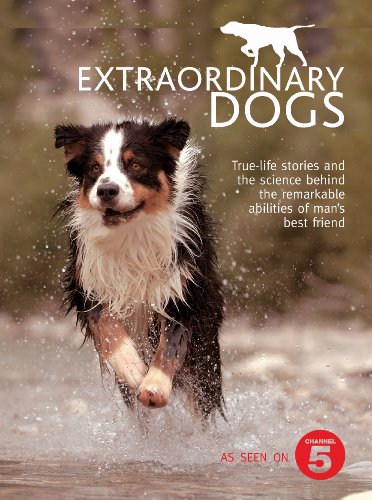
Extraordinary dogs is a collection of articles about dogs who assist human beings in an enormous variety of fields of life (and occasionally, as in the case of Scamp, who appears to recognise when nursing home residents are nearing the end of their lives; death). However it's much more than just a disjointed collection of anecdotes because each group of stories is introduced with a brief summary of the science that lies behind the dogs' abilities. It's not a book about dog training as such, but may benefit ordinary pet dogs by encouraging their owners to realise their need for mental stimulation and physical exercise.
We tend to think that of working dogs as belonging to just a few specialised breeds, but this book shows that talent exists in breeds as unexpected as the little Chinese Crested, Yorkshire terrier and Miniature Schnauzer.
For anyone who wants to find out more, there's a useful list of organisations consulted, together with their websites, but I felt it was a bit of a pity that there were no other suggestions for further reading, or references to the science involved.
The Royal College of Veterinary Surgeons has a YouTube channel with information about veterinary careers. If you love animals and are wondering about the possibility of becoming a vet this is a useful source of reliable information.
The video series is produced in association with UK Vet Schools, including the Cambridge Veterinary School which provides clinical services to our clinic and uses it for training purposes.