Lorna's just emailed me the latest results for the Market Street shop which are very encouraging.
w/e 19.02.11: £2,177.06
w/e 26.02.11: £1,438.42
w/e 05.03.11: £1,606.60
Publicity for the initial opening boosted takings in the first week, so I'm not disappointed that the 2nd and 3rd weeks weren't quite as good, especially considering the cold weather which doesn't encourage browsing at the moment.
Thank you to everyone who's supported us by donating, shopping or volunteering: please keep it up and help us to go on helping local animals. Recently these have included Jake, a small Jack Russell-type terrier who was hit by a car and will need around £500 to pay for surgery to fix his broken pelvis, and several other cats and dogs signed over to our inspectors because their previous owners could not cope.
Tuesday, March 8, 2011
First three weeks results for Newmarket
Labels:
RSPCA Charity Shop Newmarket
Sunday, March 6, 2011
Sunday at the Burleigh St shop
![]() |
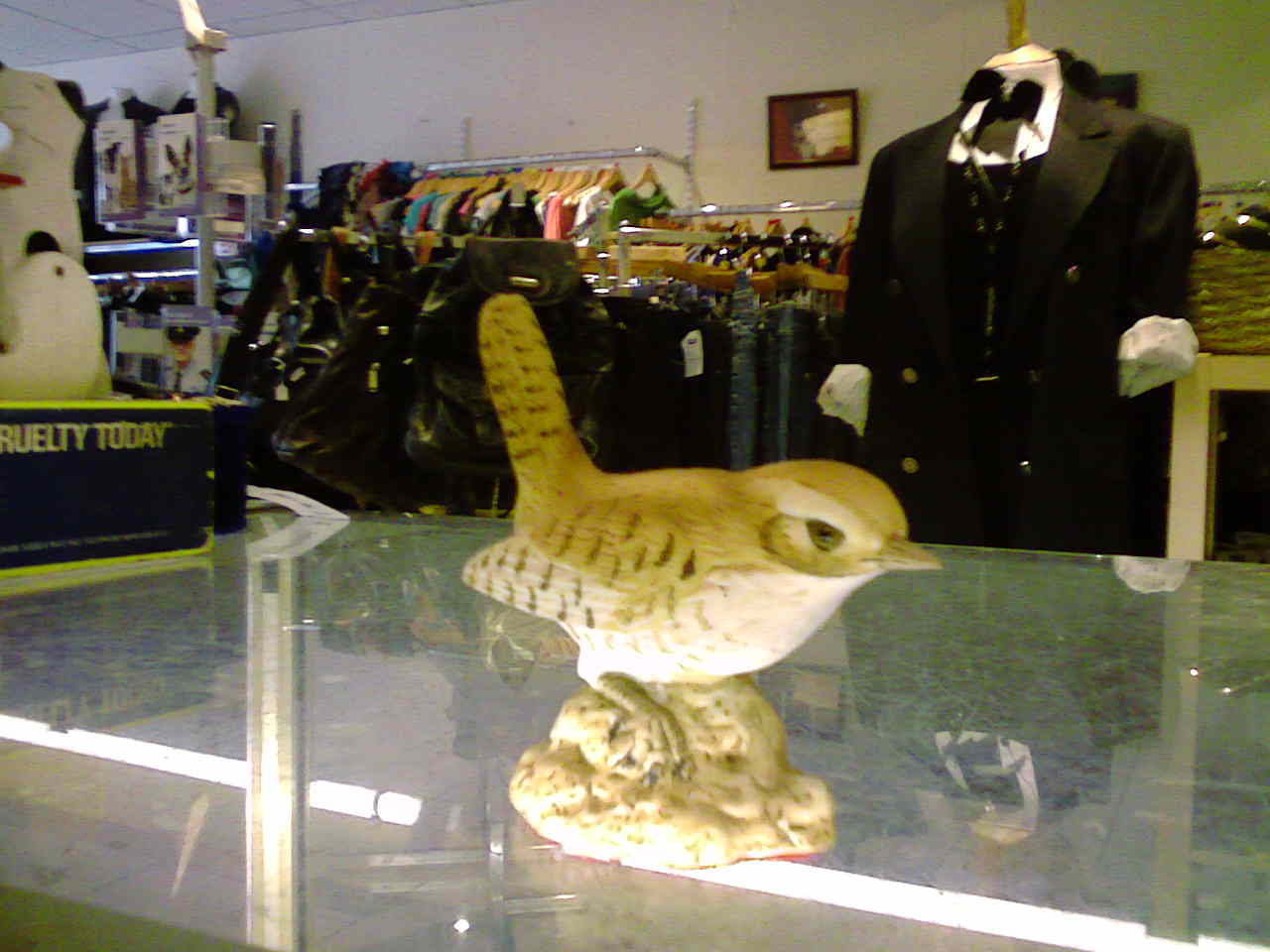
| Wren ornament |
![]() |
| Long-tailed tits |
We're regularly taking £100+ on Sundays now, which makes it well worth doing as it's more than we'd expect to raise by "stand-alone" events like jumble sales and all of it can go towards helping animals as this is the one day when it's possible to staff the shop with all volunteers.
Labels:
61 Burleigh St,
e61,
RSPCA Charity Shop Cambridge
Saturday, March 5, 2011
Inspectorate group reports for 2010
![]() |
| Fox cub stuck in netting |
I've just this morning received the inspectorate report for the Cambridgeshire branches group.
E2 ANNUAL REPORT 2010
CASES OF INTEREST
Three men from Peterborough were banned from keeping horses for 5 years after 5 horses they owned were found living on land deemed unsuitable, poor feed and no water made available. Two of the horses were emaciated. The RSPCA arranged care and treatment for the horses and are still looking to secure them good homes.
A man from Cambridge was banned from keeping all animals for 10 years for causing his dog suffering by failing to feed it properly. It was found in an emaciated state. He was also ordered to pay the society costs of £600 and ordered to complete 40 hours community service. Unfortunately due to the dogs condition and prognosis being poor the veterinary surgeon euthanased the dog on humane grounds.
RESCUE OF INTEREST
A collapsed pony was discovered on a bridle path in Peterborough. The pony was suffering from severe arthritis. The RSPCA cared for the pony and as no owner was ever found the pony was eventually rehomed.
Statistics for 2010
The "Collections" heading refers to situations other than cruelty cases where frontline staff were asked to attend sick or injured animals. These would normally be injured strays or wild animals which the person calling the RSPCA was not able to take direct to a vet.
The majority of the cruelty complaints can be resolved by giving suitable advice on correct care. This is where the branch facilities are very important as it is often the case that very low income pet owners don't obtain veterinary help because they are afraid of the cost. Our inspectors can deal with many neglect complaints by telling the owner that they must take the animal to our clinic and checking later that our records show that this did happen and that the animal's condition was treated.
E2 statistics for 2010 | |
Complaints dealt with | 4549 |
Case files submitted | 30 |
Convictions secured | 12 |
Adult written cautions | 10 |
No proceedings | 8 |
Collections | 5446 |
Thursday, March 3, 2011
Claire and Ffiona on the Andie Harper show
Claire and Ffiona were interviewed on Radio Cambridgeshire's Andie Harper show today, talking about the cost of looking after pets. The link to listen again should work for the next seven days.
It's a three hour program, so I'm afraid you have to listen to quite a lot of general current affairs before you get to the piece about veterinary treatment. Hopefully at least some of the listeners will have been motivated to think about making arrangements to ensure that they would be able to meet the cost of their pets' treatment.
Labels:
veterinary treatment costs
Wednesday, March 2, 2011
It's that time of year again...
Even a few hours collecting can bring in enough to make a real difference to local animals.
If you live in our branch area and might be able to help, please email volunteering@rspca-cambridge.org.uk
Otherwise, click on the RSPCA Week banner for more information about helping your own local branch.
Labels:
rspca week
Tuesday, March 1, 2011
More animal-related donations for sale at our Burleigh St shop
![]() |
| Badger "piggy-bank" |
![]() |
| Closer view |
Labels:
charity shop,
fundraising
Monday, February 28, 2011
Merlin
![]() |
| A wide-eyed Merlin checking in to have his external fixator removed |
Merlin has now had his external fixator off and is looking good. He'll have to be kept indoors and not allowed to jump for another four weeks, but the x-rays show his broken leg is nicely healed. Once the four weeks is up he'll be ready for adoption.
An external fixator is effectively a splint that's actually attached to the bone through holes in the leg. It means that a limb that's broken in several places can be stabilised so that the ends hold together and new bone can grow to fill the gap between. Merlin's x-rays show this process is complete and healthy new bone has completely filled the break.
Labels:
cats
Sunday, February 27, 2011
Animal Welfare Statistics for January
In January our clinic treated 232 dogs, 90 cats, 6 rabbits and 2 miscellaneous "small furries". We rehomed 2 dogs, 9 cats and 3 rabbits.
This illustrates how vital it is that we keep on raising enough money to fund the clinic, because this represents 330 animals who might either have been put to sleep or relinquished for rehoming if a low-cost option for getting veterinary treatment hadn't been available.
Where owners are caring, but don't have enough money to pay the full cost of a vet, it's much better all round if they can be enabled to keep their pets.
- It costs less than treating the animals and boarding them until they can be rehomed.
- It means animals don't have to lose the family they know and love.
- It prevents "recycling" whereby people relinquish an animal they can't afford to look after and then acquire another one.
Labels:
animal clinic,
animal welfare statistics
Monday, February 21, 2011
Monthly Volunteers Meeting - WEDNESDAY 23rd February
Please note that this month's volunteers' meeting is one day earlier than normal, because our venue, the Corner House Pub, had a previous booking for Thursday.
From March we'll return to our normal time/date of 3rd Thursday in each month, 7.30-9.30pm.
Labels:
volunteers meetings
Sunday, February 20, 2011
Animal people should be interested in Big Society (and vice versa)
This video of a talk given David Grant of the RSPCA Harmsworth Hospital last year explains why those of us who want to improve conditions for animals need to be interested in solving wider social problems. It also demonstrates why social activists and politicians who think animal welfare is simply taking away money that ought to be used for people are wrong.
When people see no reason why they should cooperate, we see things like RSPCA Manchester and Salford's despairing comments about shoplifter after shoplifter stealing from a charity that's already struggling to fund the demands from people who feel entitled to unlimited help.
"I see and hear so frequently so many people who are all too keen to pass off their responsibilities on to others; asking for help is very different and I have no problem with that. But the amount of times people are abusive and emotionally blackmailing on the phone is awful and this week it has really taken its toll. We simply cannot say yes to everything and I just wish people would have some understanding towards this fact and realise that they have to take responsibility for their actions."
None of these worries are new, nor are they party-political. The Office for National Statistics was collecting information about "Social Capital" (basically how well society functions at the level of interactions between individual people) in 2003.
The ONS definition of Social Capital says:
Social capital describes the pattern and intensity of networks among people and the shared values which arise from those networks. Greater interaction between people generates a greater sense of community spirit.and
Definitions of social capital vary, but the main aspects include citizenship, 'neighbourliness', social networks and civic participation. The definition used by ONS, taken from the Office for Economic Co-operation and Development (OECD), is "networks together with shared norms, values and understandings that facilitate co-operation within or among groups"
What are shared norms, values and understandings?
These relate to shared attitudes towards behaviour that are accepted by most individuals/groups as a 'good thing': examples are not parking in a disabled parking space at a supermarket and giving up your seat to someone who needs it more on the bus.
Without this desire to avoid other people's disapproval lots of simple things would stop working: for example running shops is only possible if most people don't steal because it would require huge numbers of personnel to force everyone to pay.
The problems we face with pet owners who can't / won't pay for their animals' treatment are escalating because more and more people believe this is someone else's responsibility; either ours or the vets.
One of the things that ONS investigated was the connection between social capital and volunteering. Using the 2000 Time Use Survey they demonstrated that volunteering increased connections between people (in simple terms, volunteering is a way to make friends). People who cooperate on shared projects are more likely to have a sense of purpose and a pride in their joint achievements (in contrast to David Grant's status dog owners with their desperate lack of self-worth).
From my point of view, at the most basic level; someone with a few friends who may own cars is less likely to phone me because they have a large dog who cannot walk and absolutely no means of getting the dog to a vet.
Obviously joint activity on its own isn't enough: the gang members have that in an almost purely negative form; status, but not a status that's worth feeling pride in. I rather suspect that combining to protest against things isn't ultimately all that satisfying either, if that's all you ever do, because it's not constructive.
Politicians and social activists should be interested in animals in society because animal protection groups are almost entirely self-supporting (if only because there is a policy of not giving them lottery grants) and because they do foster networks between people. This isn't just about charities and pressure groups; it's been demonstrated that dogs act as "social catalysts" breaking the ice and encouraging walkers to make contact (possibly not if they happen to be status dogs). An Australian study showed that pet owners scored higher on a variety of "social capital" measures than non pet-owners (for example loaning tools to neighbours).
The problems we face with pet owners who can't / won't pay for their animals' treatment are escalating because more and more people believe this is someone else's responsibility; either ours or the vets.
One of the things that ONS investigated was the connection between social capital and volunteering. Using the 2000 Time Use Survey they demonstrated that volunteering increased connections between people (in simple terms, volunteering is a way to make friends). People who cooperate on shared projects are more likely to have a sense of purpose and a pride in their joint achievements (in contrast to David Grant's status dog owners with their desperate lack of self-worth).
From my point of view, at the most basic level; someone with a few friends who may own cars is less likely to phone me because they have a large dog who cannot walk and absolutely no means of getting the dog to a vet.
Obviously joint activity on its own isn't enough: the gang members have that in an almost purely negative form; status, but not a status that's worth feeling pride in. I rather suspect that combining to protest against things isn't ultimately all that satisfying either, if that's all you ever do, because it's not constructive.
Politicians and social activists should be interested in animals in society because animal protection groups are almost entirely self-supporting (if only because there is a policy of not giving them lottery grants) and because they do foster networks between people. This isn't just about charities and pressure groups; it's been demonstrated that dogs act as "social catalysts" breaking the ice and encouraging walkers to make contact (possibly not if they happen to be status dogs). An Australian study showed that pet owners scored higher on a variety of "social capital" measures than non pet-owners (for example loaning tools to neighbours).
Labels:
Big Society,
RSPCA,
social capital
Saturday, February 19, 2011
Owl eggstravaganza!
These are just a few of the delightful owl-themed objects which have been generously donated to our Burleigh Street shop.
There are also many other attractive pictures and ornaments of birds and other animals.
If you love owls, do come along and browse.
We'd also like to thank Debenhams for donating the glass display units which show off all the ornaments most effectively.
There are also many other attractive pictures and ornaments of birds and other animals.
If you love owls, do come along and browse.
We'd also like to thank Debenhams for donating the glass display units which show off all the ornaments most effectively.
Labels:
Owls,
RSPCA Charity Shop Cambridge
Friday, February 18, 2011
Slideshow from our rehoming gallery over the past few years
Labels:
RSPCA Cambridge
Thursday, February 17, 2011
More pics from the Newmarket shop
![]() |
| Outside the shop just before the opening |
![]() |
| Inside the shop looking outward |
![]() |
| Mike Thompson welcoming the customers |
![]() |
| Books for adults and children |
Labels:
RSPCA Newmarket Charity Shop
Tabitha is Holly!
This pretty tabby girl was hit by a car and taken to the emergency vet last week. Fortunately it looks as though she'll make a full recovery, and her owner managed to make contact with us by phoning all the local vets asking if they'd taken in an injured female tabby.
Ideally all cats should be micro-chipped to make immediate identification possible. However, if your cat goes missing and is not chipped, do phone round vets, including ones that seem quite a long way away from your home. If an animal is found injured outside normal working hours, the closest available vet may be some distance away.
Also, remember that most "lost" cats have actually got shut in somewhere. Regardless of whether or not your cat is chipped, ask all your neighbours to check any sheds, garages, greenhouses etc. that may have been opened and later shut with your cat trapped inside.
Update
Sadly it turns out that Tabitha isn't Holly after all. The lady who had lost a tabby cat came down and Tabitha has no white on her at all, while Holly had a very small amount. So Tabitha is still looking either for the person who has lost her, or for a new permanent home.
Ideally all cats should be micro-chipped to make immediate identification possible. However, if your cat goes missing and is not chipped, do phone round vets, including ones that seem quite a long way away from your home. If an animal is found injured outside normal working hours, the closest available vet may be some distance away.
Also, remember that most "lost" cats have actually got shut in somewhere. Regardless of whether or not your cat is chipped, ask all your neighbours to check any sheds, garages, greenhouses etc. that may have been opened and later shut with your cat trapped inside.
Update
Sadly it turns out that Tabitha isn't Holly after all. The lady who had lost a tabby cat came down and Tabitha has no white on her at all, while Holly had a very small amount. So Tabitha is still looking either for the person who has lost her, or for a new permanent home.
Labels:
found cats
Wednesday, February 16, 2011
Update on Roxy
![]() |
| Roxy |
This is Roxy, the Staffy who was brought in as a cruelty case. She loves everybody in spite of having been treated as a punch bag. Now fully fit and ready to go to a new home.
Labels:
rehoming dogs
Tuesday, February 15, 2011
Pics from the Newmarket Shop opening
![]() |
| Shopping here benefits the environment as well as helping animals |
![]() |
| A smiling Mark Thompson welcomes the customers |
![]() |
| Chief Inspector Mark Thompson cuts the ribbon |
![]() |
| People were queuing down the street to get in |
![]() |
| Volunteers getting a well-deserved cuppa |
![]() |
| Slightly alarming severed hands display jewellery! |
![]() |
| Shelves packed with something for everyone |
We made over £700 on the first day and £329 today.
Please keep the donations coming, as with sales as good as this we need to keep the stock coming in.
Thanks and congratulations to Lorna and her team of volunteers who all worked so hard.
Labels:
RSPCA Charity Shop Newmarket
Saturday, February 12, 2011
Ignore Valentine's Day: this is much more important
Don't forget! Put it in your diaries. Set your electronic calendars.
Chief Inspector Mark Thompson will be opening our new charity shop at 10A Market Street, Newmarket at 10 am on Monday 14th February: this coming Monday!
Please come and give us your support. The Newmarket group have worked their hearts out getting the shop ready; now they need your help to make it a success.
Labels:
newmarket charity shop
Thursday, February 10, 2011
Extraordinary Dogs: book review
Extraordinary dogs is a collection of articles about dogs who assist human beings in an enormous variety of fields of life (and occasionally, as in the case of Scamp, who appears to recognise when nursing home residents are nearing the end of their lives; death). However it's much more than just a disjointed collection of anecdotes because each group of stories is introduced with a brief summary of the science that lies behind the dogs' abilities. It's not a book about dog training as such, but may benefit ordinary pet dogs by encouraging their owners to realise their need for mental stimulation and physical exercise.
We tend to think that of working dogs as belonging to just a few specialised breeds, but this book shows that talent exists in breeds as unexpected as the little Chinese Crested, Yorkshire terrier and Miniature Schnauzer.
For anyone who wants to find out more, there's a useful list of organisations consulted, together with their websites, but I felt it was a bit of a pity that there were no other suggestions for further reading, or references to the science involved.
The Channel 5 series it accompanies is on now.
Labels:
Book reviews
Interested in training as a vet?
The Royal College of Veterinary Surgeons has a YouTube channel with information about veterinary careers. If you love animals and are wondering about the possibility of becoming a vet this is a useful source of reliable information.
The video series is produced in association with UK Vet Schools, including the Cambridge Veterinary School which provides clinical services to our clinic and uses it for training purposes.
Wednesday, February 9, 2011
Sheep rescue in Caernarfon, North Wales
RSPCA inspectors abseil down a cliff to reach a sheep trapped on a ledge.
Not suitable for anyone who doesn't like heights!
Labels:
RSPCA Inspectors
Thursday, February 3, 2011
Another poor little mite
She's about three years old and was rescued by a policeman who saw her in the street being kicked in the head by her owner. Richard, our inspector, and the kennel staff, all say she's a lovely natured dog in spite of her background of abuse.
Of course, she is another Staffie.
Her owner would not cooperate by giving us any information which might help in rehoming her, not even to tell us her name.
Labels:
staffordshire bull terriers
Wednesday, February 2, 2011
10A Market St. starting to look good
![]() |
| Work in progress |
![]() |
| 10A Market St - some work on the exterior still not quite finished |
Labels:
RSPCA Charity Shop Newmarket
Never blog when your temperature is more than 100 degrees
Naturally readers who can do subtraction will have noticed that 14 minus 1 = 13 not 5.
Our new shop at 10A Market Street, Newmarket is opening on Monday, 14th February, 12 days from now.
Labels:
RSPCA Charity Shop Newmarket
Tuesday, February 1, 2011
Five days to go
Only five days now until our shiny new charity shop opens at 10A Market Street, Newmarket.
Many thanks to RSPCA HQ for demonstrating their confidence in us by giving us a loan of £18,000 to fit it out.
Lorna and Val have been working hard putting up the new rails and shelving, and the gift aid tills should be delivered on Friday.
Labels:
RSPCA Charity Shop Newmarket
Monday, January 31, 2011
So, you've joined an RSPCA Branch Committee?
The first thing that will probably strike you is that there's a lot of paperwork and that meetings are run to a fixed agenda that may seem bureaucratic until you get used to it. Meetings start by reading through the minutes of the previous meeting and checking that everyone agrees they are an accurate record. This may appear tedious, but it's vital to have written proof of what was actually agreed if there are problems later on.
A branch committee meeting is only allowed to make decisions if there are at least 4 elected committee members present.
The next thing is that really quite frighteningly large sums of money are involved. In our case the bill for animal boarding runs at roughly £2,000 each month. The basic fee to staff our animal clinic is £2,500 and on top of that there are costs for veterinary treatment of the animals we take in and general items like rates, heating and repairs.
As a branch, our life is a constant balancing act between not going bust altogether and constant demands to find, "just another £200" in order to save an animal's life.
The trouble is that ONE payment of £200 is not much in relation to our turnover BUT £200 repeated every day would finish us off unless we can increase our income.
Labels:
branch committees,
branch costs
Sunday, January 30, 2011
Is anybody out there?
I sometimes feel that way, and evidently RSPCA HQ are the same as that's the heading of their latest volunteer survey.
If you do volunteer for the RSPCA, I urge you to complete the online form - especially if there are things you would like to see changed or have irritated, annoyed or upset you. If we don't KNOW about problems we can't fix them.
If you are a volunteer and you complete the form you'll be entered into a draw to win a day out with one of the inspectors.
In some ways the people we really need to ask are the ones who considered volunteering and either never got started or else drifted away. It came up on the i-volunteer discussion board a few days ago and, allowing for the fact that this was just one person's experience, one problem that can be fixed seems to be an explanation of why volunteers can't automatically attend and vote at branch committee meetings or vote at the branch AGM and what they need to do if they would like to get more involved in decision-making.
RSPCA branches are registered charities in their own right, governed by the RSPCA Rules for Branches, and ultimately by the Charity Commission. We can't simply re-write the rules to suit ourselves, or the result would be chaos, and because large amounts of charity funds are involved there have to be set procedures to specify who is eligible to elect the committee. Committee members are personally responsible for proper management of branch funds (and could ultimately be made to pay them back if things went really wrong). If random people could attend committee meetings and vote there would be no way to hold them to account, and it would be very awkward if it was possible to come to a meeting, push through some hugely expensive project and then leave everyone else to cope.
If you are an existing volunteer, or a new one, and are interested in taking part in decision-making at local or national level, the first thing you need to do is to join the RSPCA. (Make sure you request that your details are passed on to the local branch and that you become a branch member as well as a national one).
Three months after your application has been processed, you will be eligible to vote and stand in branch elections. You should automatically be sent details of the date of your own branch's Annual General Meeting (which is where the elections take place) and a nomination form which you can use to submit yourself as a candidate for election to the committee. You need to get supporting signatures from two other branch members (usually if you contact the existing committee they will be only too delighted to arrange this as most committees are short of members).
For a valid election the branch AGM must be attended by at least 10 members and each committee member needs to receive at least 50% of the votes of those present in order to be elected (members can vote for as many candidates as they like, but can only place one vote per candidate).
Once you have been elected, your troubles will be only just starting...
Labels:
branch committees,
joining the rspca
Saturday, January 29, 2011
Dog foster home needed
One of our clinic clients needs to find a temporary or permanent home for a four year old Labrador dog due to health problems (partly hers and partly the dog's).
The dog is well-behaved, friendly and placid, but has begun having occasional fits - so far only 1-2 per month, which the clinic vets have advised should be monitored, but not treated by medication at this stage. When he has a fit he loses control of his bladder and threshes about in a way which means he would be a risk to small children because of his size and strength. For the same reason he probably ought not to be left alone with other dogs. He's never shown any signs of aggression other than reflex snapping when actually having a fit.
Ideally he needs to be placed in a home where he can be restricted to areas where the seizures won't do any damage (to him or to furniture and carpets) and where he can be left to recover quietly in his own time.
If you might be able to help, please email rehoming@rspca-cambridge.org.uk
Labels:
dog fosterers
Friday, January 28, 2011
Snap?
If you've been following the discussions about "Big Society" and the rôle of charities, you may be aware of Parliament's Public Affairs Select Committee investigation on the Funding of the Voluntary Sector. The minutes of evidence are rather long, but I was very interested by the asides about the distinction between "campaigning" and "service" charities, with some of the questioners being quite hostile to the idea that charities should try to bring about changes in the law or in the way people behave.
The Chief Executive of Marie Curie Cancer care rebutted the claim as follows:
"It seems to me that it’s a pretty fundamental principle that free organisations and free associations can campaign-that’s important. I think there needs to be a balance between campaigning and service provision, and often charities will use their experience of providing services to influence public policy. They will say, "Look, we realise that caring for people with cancer requires a different approach, and we’re going to campaign to ensure that different approach." There wouldn’t be a hospice movement if there hadn’t been both the provision of hospices by the charitable sector and also arguments on the need for more of them. It’s a combination that often takes place. Different charities will make different decisions about the balance of that. I think the best charities combine the provision of direct services and the use of knowledge to influence policy. That’s the important principle I think."
Fired by his example, I'm cross-posting from a piece I did a few months ago on our i-volunteer page about campaigning and animal charities.
Some animal protection organisations see their primary role as the direct provision of welfare services (for example rehoming animals), while others are primarily orientated towards campaigning, or education. A few combine the two, and this may cause them some problems.
On the one hand they may be accused of diverting funds intended for animal welfare services into "political" activity (with a small p). Or, on the other, of failing to tackle basic questions of how we ought to treat non-human animals in favour of "safe" options which are acceptable to the general population.
I think this idea that providing services and campaigning are somehow natural opposites is false and actively harmful. "Speaking out for animals" may be all very well, but it isn't likely to do them very much real good unless it's backed by knowledge (which animal welfare practitioners are more likely to possess than purely theoretical campaigners). It may do them actual harm if the campaigns are based on wrong, outdated or incomplete knowledge.
On the other hand if the practitioner sees recurring problems which could be solved by education or changes in the law, it makes no sense to say, proudly: "All our money is spent on direct provision of services."
So far as I'm aware, the RSPCA is unique in providing a free service which the State would have to spend money to replace if we collapsed. The PDSA provides services which effectively top up the benefits of very poor people who depend on pets for companionship, but there would be no statutory requirement for any kind of replacement. So long as anti-cruelty laws are on the statutes there would have to be at least a minimal amount of enforcement, even if many cases would simply be disregarded as not a priority. So, in a strange, back-to-front way we're almost the ideal "Big Society" organisation, raising our own funds to provide a better service than the state would do, but at the same time saving public money by funding work the state would have to do if we weren't there. The network of RSPCA branches was doing things locally nearly a century before the Big Society Network was thought of. "Mending our communities" may be a little too ambitious, but we are providing local services for low-income families with pets.
Labels:
animal welfare,
Big Society,
campaigning
Wednesday, January 26, 2011
Charity Shop opening date February 14th
We now have a date for the opening of our new charity shop in Newmarket.
10A Market street will open for business on Monday 14th February. This will give the volunteers a chance to practice with the new tills during the relatively quiet weekday period ready (I do hope) for a really busy Saturday.
There will be staff and volunteers in the shop working on setting up from 29th January onwards and they will be more than delighted to take in donations of items for sale. Market street itself is pedestrianised, so if you are dropping off donations by car it would be best to contact us first for directions to the access road at the back of the shops. Email newmarket@rspca-cambridge.org.uk or phone 07766 502 032 (note that the location on Google maps correctly identifies the access road, but shows the back of the wrong shop.
If you are interested in volunteering in the shop, please download and complete our shops volunteers form and bring it with you. We need to keep a record of who to contact in an emergency and whether our volunteers have any health conditions which mean we need to make adjustments to their work patterns (for example avoiding standing for long periods).
Labels:
charity shops,
Newmarket
Monday, January 24, 2011
Newmarket Shop will be opening in February
The shopfitters are due to hand the refurbished shop at 10A Market Street over to us tomorrow, although there are some minor jobs still to do. We then have to put up the rails for clothes, install the new Gift Aid tills, and stock the shop.
From Wednesday onwards there will be staff and volunteers in the shop for most of the day and they will be delighted to take in donated items. Unfortunately the phoneline is not yet connected, so it's not yet possible to phone ahead. Market St is pedestrianised, but if you want to drop off donations by car there is access to the rear of the shop from the service road off the A142.
We need more volunteer, for a variety of tasks, not just staffing the till.
We need people to help with sorting and cleaning donated items (a good wash in soapy water can vastly improve the saleability of ornaments and bric-Ã -brac). Also, people to fill shelves, put clothes out on the rails and help with moving larger items.
We also need people who would be willing to distribute leaflets and help with publicity to ensure that the opening is a success as first impressions are so important.
Car drivers willing to collect donations from elderly or non-driving donors would be a great help.
If you would be interested in volunteering, please email newmarket@rspca-cambridge.org.uk
We need more volunteer, for a variety of tasks, not just staffing the till.
We need people to help with sorting and cleaning donated items (a good wash in soapy water can vastly improve the saleability of ornaments and bric-Ã -brac). Also, people to fill shelves, put clothes out on the rails and help with moving larger items.
We also need people who would be willing to distribute leaflets and help with publicity to ensure that the opening is a success as first impressions are so important.
Car drivers willing to collect donations from elderly or non-driving donors would be a great help.
If you would be interested in volunteering, please email newmarket@rspca-cambridge.org.uk
Labels:
newmarket charity shop
Thank you to everyone who donated items to our shop yesterday
Just a quick thank you to everyone who dropped in donations to our Burleigh Street shop yesterday.
We're now opening Sundays 11 am — 4 pm, and so far it looks as though sales aren't huge, but it's a more convenient day for many people who want to donate items for sale.
Labels:
charity shops,
fundraising
Monday, January 17, 2011
Next Volunteers' meeting
Just to remind you all that our volunteers meeting is this Thursday at the Cornerhouse Pub on Newmarket Road. They do good food, it's warm, and there will be drinks so if you have a free hour or two we would love to see as many of you there as possible.
Things will get started around 7.30pm so we look forward to seeing you there! Any questions about the venue etc. please get in touch. If you are unable to make this meeting don't worry and we hope to see you in February!
Labels:
volunteers meetings
Friday, January 14, 2011
Update on our shops
FINALLY our new shop at 10A Market Street in Newmarket is really close to opening. The shopfitters will be starting work this Monday and should be finished by the 30th of this month. Our projected opening date is 1st February, but it's possible this may slip a little depending on how long it takes us to put all the stock out and do final tidying up.
We will be installing some of the new "gift aid" tills which will make it possible for donors to gift aid the proceeds of sale of their donated items if they are UK tax payers. The way this works is that the donor fills in a short form when they leave donations and the items are bar coded so that their sale can be tracked through the till. When a gift-aided item is sold, we send off a letter to the donor letting them know how much was raised and checking that they still want to give it to the charity. Provided they are happy for us to keep the money, they need do nothing more and we send off a monthly claim to the inland revenue who will give us an amount equal to the tax that the donor paid on an equivalent sum of their normal income. The system also helps us track our stock as it means an automatic record is kept of donations coming in and sales going out. We plan to install the new tills in both the Burleigh Street and the Market Street shops.
If you've been to 61 Burleigh Street recently you'll have noticed that our staff and volunteers worked hard over the Christmas "break" to put in a new "books and media" section in the raised area that was previously used for storage. This has approximately quadrupled the existing shelf space for books, CDs, videos and DVD's while making room in the rest of the sales area for more clothes and other items.
We've done some rationalisation of the shelves at our second hand bookshop at 188 Mill road and it is now staffed entirely by volunteers for half of the week. We would like to say a very big thank-you to the volunteers for agreeing to take on this extra level of responsibility. It is VERY much appreciated and will make it possible to continue with this shop which is much loved, but unfortunately does not have sufficient trade to cover the wages of a full-time manager and still make a profit to be used for the welfare work of the branch.
Please visit our shops to support the volunteers and make all their hard work worthwhile.
We also need donations of anything saleable. We move stock between the shops, so please feel free to take items to whichever is most convenient for you.
Labels:
charity shops,
fundraising
Tuesday, January 11, 2011
Branch volunteering and "Big Society"
There's lots of discussion about "Big Society" but not much light about what it may mean in practice; particularly for voluntary organisations which already exist.
Having experienced initiative after initiative over twenty-odd years on the branch committee, what would I like to see?
- A single point for organisations to sign up as bodies who can take volunteers. One of the most frustrating things for me has been the waste of my time completing repetitive forms for each new bright idea about encouraging volunteering that emanates from Whitehall. I'd like to see a system (possibly using the existing volunteering add-on to our Charity Commission registration) that let us register as bona fide users of volunteers who are not either axe murderers or operating suicidally dangerous premises. Having done that once we wouldn't need to keep confirming that, yes, we do have a health and safety policy, Employers' Liability Insurance etc.
- Recognition for existing volunteers if we (and they) choose. There are large numbers of people who have volunteered for years and years because they have no realistic prospect of getting paid work and they want to put something back into society. In an absolutely ideal world I think there would be an option for people like this to have an alternative type of benefits (maybe called something like volunteering tax credits) that was not a way of forcing or bribing people to "volunteer" but recognising their choice to make a contribution rather than sitting at home watching daytime TV.
- A centralised and simple way to record the amount of time volunteers have put in (maybe a website where we could submit details). Again it should be up to the volunteer and the organisation whether they want to be included.
- A single system which could be used to register any volunteer instead of the present alphabet soup of initiatives aimed at getting people into meaningful activity. Ideally this could be used to produce references and some information about what they've done to assist them in future job applications, and would be computerised rather then involving more bits of paper.
- Sort out the position of volunteers under the age of 18; most urgently those who are under 16. At the moment if a volunteer under the age of 15 wants to work in a charity shop, the shop has to apply for special permission from the local authority, and must do this for each volunteer. It would make youth volunteering much more of a practical proposition if each place where young people were to volunteer had just one set of registration requirements and only had to do one generic risk assessment of the venue's suitability for young people, rather than an individual assessment for each young person. It would also help if there was some sensible reassessment of the need for background checks of adults who will be working alongside young volunteers.
At present I strongly suspect that some young people are drawn into risky forms of activism simply because more responsible organisations dare not involve young people because of the difficulty of staying within the law.
- An educational component in all volunteering activity, to be developed by the organisation with the aim that the volunteer would learn something meaningful about the functioning, purpose etc. of that organisation, rather than simply being used as an extra pair of unskilled hands.
- A more sensible attitude to using volunteers for tasks that are sometimes done by paid staff, rather than the mantra that "job substitution" is to be avoided at all costs. Of course it would be unacceptable (and a breach of employment law) to sack paid staff and replace them with unpaid volunteers. Some roles (such as the inspectorate in our case) would be quite unsuitable for volunteers. But there is nothing magical about being paid and it is equally unacceptable to waste charity funds through a bigoted attitude that volunteers must always be subject to a paid manager and not expected to take responsibility. Voluntary organisations are not job creation schemes and, in the long run, this kind of attitude helps no-one because properly-used volunteers release funds that can be used to employ paid professionals for the tasks that genuinely can't be done by anyone else.
- A sane attitude to using volunteers to save money — of course this is a good thing (provided it can be done without detriment to services). There is nothing to be ashamed of in using volunteers to stack shelves if it means another dog or cat can have a fracture repair done by qualified veterinary staff.
Labels:
Big Society,
volunteers
Monday, January 10, 2011
Animal Welfare Statistics for 2010
During the whole of 2010, our clinic provided a total of 4,165 treatments, of which 2,786 were for dogs, 1,243 for cats, 87 for rabbits, and 49 for miscellaneous "small furries".
We also neutered 246 animals, chipped 248 and rehomed a total of 22 dogs, 67 cats, 11 rabbits and six miscellaneous animals.
In addition, our partner, the rabbit residence rescue rehomed a much larger number of rabbits with financial help from us for neutering and vaccinations. I don't yet have these figures, but will include them later.
We also neutered 246 animals, chipped 248 and rehomed a total of 22 dogs, 67 cats, 11 rabbits and six miscellaneous animals.
In addition, our partner, the rabbit residence rescue rehomed a much larger number of rabbits with financial help from us for neutering and vaccinations. I don't yet have these figures, but will include them later.
Labels:
animal welfare statistics 2010
Sunday, January 9, 2011
Thank-you RSPCA HQ!
I've just been notified by HQ that our application for a grant to restart our emergency assistance at private vets has been approved. This means that we will be able to give at least some help to animals whose owners have not registered them at our clinic if they have an emergency which can't wait until our next ordinary clinic session.
HOWEVER:
The amount of money which will be available for each individual animal will necessarily be strictly limited; if we don't do this it will simply run out within a couple of months. Most of the time it will simply cover the vet's consultation fee, plus some initial first aid aimed at keeping the animal alive and pain-free until they can be transferred to the next available session at our clinic.
It will not be possible to cover expensive surgery which cannot wait, such as emergency pyometria or caesarian operations, so please, please, if you have a bitch or female cat and would not be able to pay for this yourself, get her spayed unless there are medical reasons why this can't be done.
If you are on benefits (including working tax credit etc.) and know you would struggle to afford emergency treatment for your pet (or could not afford to take him/her to a vet at all), PLEASE get them registered by taking them to one of our standard sessions for a check-up or get them microchipped or vaccinated at the clinic. If they are not vaccinated and belong to a species (cat, dog, rabbit) which needs this, getting it done will protect them from several nasty diseases and will also mean that they are registered. Our veterinary service provider is only prepared to see registered animals outside normal clinic hours.
Registration only applies to an individual animal; if you have multiple animals it is essential that they all visit the clinic.
Labels:
animal clinic,
veterinary treatment costs
Wednesday, January 5, 2011
New year looking rather black for sick pets
Veterinary costs are going up in a terrifying way and the increased rate of VAT is going to mean another 2.5% hike on everything.
We desperately need to increase our income so that we can raise the amount of subsidy we pay in order to reduce the amount that users of our animal clinic are charged by our veterinary service provider.
The way this works is that we pay the service provider (Cambridge University Vet School) a yearly fee and in return they staff our clinic and provide hospital facilities for inpatients back at the Vet School. Pet owners pay us a consulation fee of £10 and are charged by the University for drugs and operations at a special reduced rate. However the amount of the reduction depends on how much we are able to pay (currently it works out at about £54,000 p.a.).
Unless we can increase our contribution fairly substantially so that we are subsidising a larger proportion of the fees I very much fear that the amount the University charges pet owners will be unaffordable for many very low income families.
Labels:
animal clinic,
veterinary treatment costs
Sunday, December 26, 2010
Fighting the last war...
The UK has a 94.75% save rate for stray dogs collected by local authorities. I don't know of any comparable statistics for cats, but the RSPCA's internal figures indicate a 95% save rate for cats without severe injuries or illness.
There is a problem of unwanted pets in this country, and dealing with it is rather like painting the Forth bridge, but it is manageable with effort, good-will and provision of subsidised pet neutering services for owners on low incomes and TNR (Trap Neuter Release) for feral cats. There is a worse problem in Ireland, and some UK-based rescues have made a decision to bring animals in from there in order to give them a guaranteed future.
So why are we being pushed into fighting the last war instead of dealing with the current one, which is the problem of ensuring that sick or injured animals (whether owned or not) receive at least basic first aid and that all animals taken in as cruelty/neglect cases have a guaranteed safe place to go? Why, indeed, is the battle to provide 24/7 access to basic first aid at risk of being lost as a result of what seems to be a combination of malice and self-righteousness?
The RSPCA is the only animal welfare organisation in England and Wales which runs a 24/7 365 day general-purpose rescue service, with a telephone helpline provided by our national control centre and frontline staff working round the clock. It's the only organisation with a network of volunteer branches (some admittedly not in a very thriving state) covering the whole of England and Wales and dedicated to rehoming the animals rescued by the frontline staff.
A lot of our problems stem from the fact that everyone with a special interest that falls within the remit of the RSPCA thinks that it ought to get first call on our efforts.
Or, alternatively, this, this and this (being middle of the road is a recipe for getting shot at from both sides).
Every one of these special interest groups attempts to stop donations to the RSPCA and to discourage people from joining the Society except with a view to forcing it to further the special interest. All of them are primarily interested in taking, not giving and ultimately that simply won't be sustainable.
I worry about the impact on the next generation of potential members, volunteers and trustees of the RSPCA branches. If they are continually hearing variations on: "I will not give a penny to the RSPCA, because they have not said one single word about ..." (never mind that the missing words may be diametrically opposed), it must be having some effect.
I suspect there is already a generation which has been diverted into efforts that are at best less productive than they could be, and at worst coming very close to focussing on what are virtually fantasy animals instead of those who can be helped and need help right now. We are keeping the affection of the broad public, but losing those people who would have become the dedicated volunteers and trustees needed for the immense effort of running successful branches.
If you want animal welfare work to continue to progress in England and Wales, please consider joining the RSPCA and supporting the practical, educational, and, yes, campaigning, work that we do.
If you have any doubt that the UK situation is better than in the US, please take a look at these web-pages:
Labels:
membership,
veterinary treatment costs
Subscribe to:
Posts (Atom)