Showing posts with label Big Society. Show all posts

Friday, September 23, 2011

Ironic

Someone using the pseudonym Richard Martin has been systematically putting in freedom of information requests to police authorities asking for details about data sharing between the police and the RSPCA inspectorate using the whatdotheyknow  website. You can see the progress of some of these if you search the site and responses are starting to filter back now.

The reply from South Yorkshire police is rather interesting (they're explaining why it would take too long to examine every record of communication between the RSPCA and the police in order to report whether information was being given to the RSPCA by the police or vice versa):

"Since 1st Jan 2005 there are 7354 incidents where the phrase 'RSPCA'
appears in the incident somewhere.

In order to ascertain if the incident relates to requests for information
would require checking the incidents.

There are over 380 incidents where the source name or the source location
includes the phrase 'RSPCA' indicating the call has come from RSPCA rather
than SYP requesting RSPCA.

To view the 380 would take over 30 hours based on 5 minutes per incident."
On this basis it appears that South Yorkshire police made about 20 requests to the RSPCA for every one request from the RSPCA to South Yorkshire. It probably doesn't represent a huge proportion of their total workload, but it does suggest that the RSPCA saves quite a bit of public money by dealing with problems that the police would have to pick up if we didn't exist.

Thursday, August 18, 2011

Just managing decline...

Bobby needs a home
Is not something we should ever accept.

Currently we are stuck in a series of vicious cycles and unless we can break out and convert them into virtuous cycles things are just going to get worse.

For years RSPCA branches have struggled against a perception that they have almost unlimited resources and are simply being mean when they can't do everything.


We've gone on throwing everything we have into efforts to improve in the hope that finally enough of the animal-loving public will understand we are doing all we can and be won over into giving their support.

Every time we can't do enough someone will go away to tell all their friends that "The RSPCA doesn't care," and, in the next turn of the vicious cycle,  our resources are even more limited.

Unless we can turn this round we'll end up in a situation where injured strays are kept alive just long enough to give an owner some chance of locating them and otherwise put to sleep because no-one can afford the cost of treatment. Understandably, vets hate it when this happens and it's probably one of the biggest reasons why so few vets and vet nurses are RSPCA members. 

Ultimately, the solution is in their hands. If animal welfare professionals want a different RSPCA it's up to them to join and participate. 

We can't offer free treatment to every local pet owner who is on a very low income, but we can give them the option of taking responsibility and registering at our clinic so that they can access low-cost treatment in an emergency.

However hard they work 60-odd volunteers and 200 subscribers have no possible way of satisfying the amount of need that exists. Four thousand people all contributing what they can do to help could bring about a situation where all treatable strays could be saved and found new homes and all pet owners in genuine need could be given access to affordable veterinary treatment.

In some ways the deteriorating animal welfare situation mirrors attitudes behind the rioting in London. People being told there's no point in using democratic options to make their views known because everything's corrupt. Being told nothing they personally can do will help them improve their community. Thinking they're entitled to more and being aggrieved when they don't get it. Believing there's no need to take personal responsibility for anything because someone else will always have to sort things out. Destroying instead of building.

The only way to get anything worthwhile done is to cooperate. None of us can expect to get precisely what we want, but working together gives us a heck of a better chance of getting close. 

Sunday, July 17, 2011

Rollercoaster week

After the high of our dog show, I got home to find Bambi hiding under my bed and obviously not well. Taxi to the 24 hour vet and she was put on a drip to support her liver, but sadly further tests and a scan showed that she'd finally gone into liver failure, 3 years after I adopted her, having been signed over to the branch by her previous owners, who couldn't cope with her medical condition.

Fifteen years isn't bad for a cat who developed a chronic condition at twelve, but I'm torn between relief that she had good quality of life right up to the last few days and sadness that it all happened so suddenly. Cycled over to the vet after working in the shop last Sunday and she's now buried in my garden.

As we approach the holidays, schools and youth groups start to think about end of term activities, and it's excellent that the St Matthews school Brownie pack and Barton Primary school were both kind enough to organise fundraising events to support us. Let's hope the children who got involved will be the RSPCA volunteers and trustees of the future.

Saturday was horribly wet, but today we had one of the best Sundays at the Burleigh St. shop for a long time, taking over £250. Very many thanks to all the people who donated so many really attractive items. 

The desperate need to keep funds coming in was made all too clear too, as I had two calls for help with the consultation fee for very sick animals. If we hadn't been here neither of them would have been seen by a vet today. 

This always involves very difficult decisions when we're called outside normal consulting hours, and the animal isn't registered with our clinic, as it's so expensive just to be seen and any help we give would go much further if it could wait until morning. Vets can't always tell whether something really is serious by asking the owner over the phone. 

Occasionally their judgement can be hopelessly wrong, as happened to me some years ago when a vet assured me the owner was just making a fuss, but in fact the cat didn't survive the night. I felt dreadful, and of course the owner blamed the RSPCA for the cat's death.

Saturday, July 9, 2011

First pics from the dog show

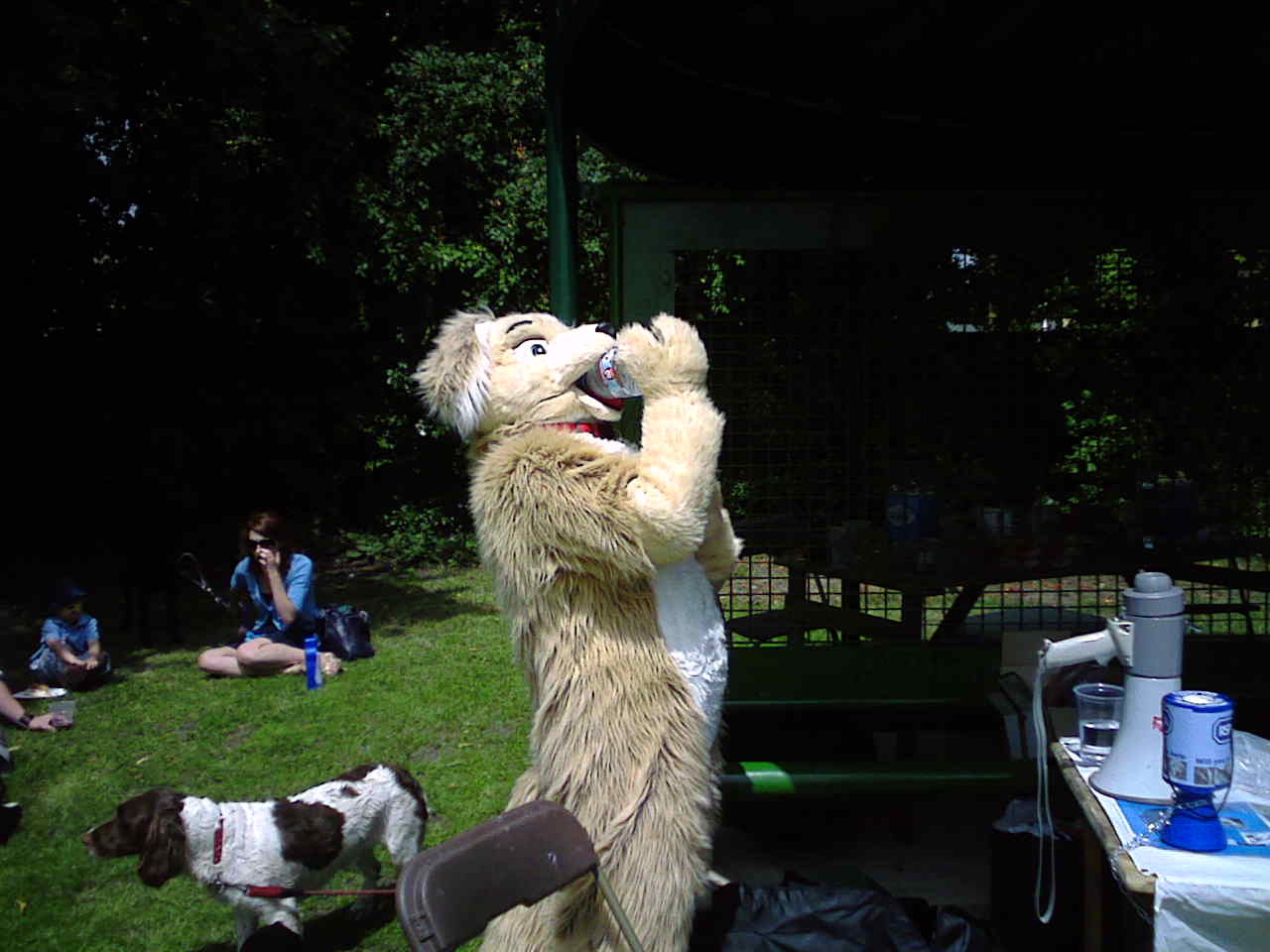
These were taken from my phone, and some of the people with proper cameras will have better shots, but they do give a feel of how the day went.

In spite of a few heavy showers everyone seemed to enjoy themselves and we raised over £500. The Shelford Feast organisers have said they would be happy to consider letting us do the show as an annual event and it looks as though there's lots of scope for improving our total next year with the experience gained from this time.

Rain clouds blowing up


Heroic collector in dog suit


Rehydrating our shaggy dog collector


Face painting


Judging the best veteran


All in all this was a really positive event, with several visitors taking membership leaflets, and some of them taking advantage of the opportunity to get their dogs chipped.

Thursday, June 23, 2011

So, what needs to be done?

Really not a huge amount per individual person. Our current problem is that the number of people who see the RSPCA as a service to be used is just too big in comparison to the number of volunteers who are struggling to provide the service.
  1. If 400 extra people donated just one carrier bag of saleable items at any of our charity shops, it would raise £4,000
  2. If they all completed a gift aid form that would add another £1,000.
  3. If 20 people with an interest in books and reading volunteered for half a day each week at our 2nd hand bookshop on Mill road they'd raise an extra £12,000 each year.
  4. If 5 more people volunteered for half a day each week at our Burleigh St shop they'd raise an extra £200 per week — £10,000 over the course of a year — by increasing the rate at which donations could be processed for sale.
  5. If 100 extra people visited our shops each week and all made just one purchase at each visit it would raise £13,000.
  6. If 200 people from our branch area did nothing other than join the RSPCA, we would have £1,000 as our share of their subscription fees.
  7. If 20 of them regularly attended our AGM each year we wouldn't have the annual worry that the AGM would be invalid and need to be held again,  due to low turnout.
  8. If 2 of them were prepared to join our committee it would mean we could be certain of having enough trustees to comply with the regulations for a valid RSPCA branch. 
  9. If 100 people each volunteered to collect for just one hour during RSPCA week (and were prepared to collect their tins etc. from us rather than having one of us deliver it to each of them) they'd raise £2,400.
  10. If ten people each got together with friends and organised their own fundraising event (coffee morning, open garden, car boot sale etc.) they'd raise £1,000.
That would secure the basic fee we have to pay for veterinary services at our clinic and mean our existing fundraising activities would comfortably be able to cover the additional costs of boarding and rehoming injured strays and cases from the Inspectors and ensuring that animals needing surgery could be treated.

Monday, May 30, 2011

Adding up the costs

Some days I really worry that I am channeling the Reverend Arthur Broome, famous as the original founder of the RSPCA — but also for being thrown into the debtors' prison when he couldn't raise enough cash to cover the Society's outgoings.

Everyone seems to feel entitled to something from us, and it is rapidly getting to a point where things are completely top-heavy, with the number of people who think we should be doing, or paying for, something hugely more than those who want to help our work.

Part of the problem is that there is no useful feedback to animal owners to impress on them that they must do some planning about what they'd do if their pet was ill or injured. So many have no idea it may cost £100 just to have their animal seen—not treated—by a vet, on a Sunday or bank holiday. At that point tears and pleading won't do any good; lots of them genuinely don't have the ability to lay their hands on that amount of money at short notice.

If I'm unlucky and we get five of them in a day, then it's £500 spent that we can't afford—and most probably the animals will be put to sleep because actual treatment would have meant another £200-£600 that the owner doesn't have. Those five individual owners may have learned a terrible lesson (or they may simply go away thinking their pet died because we didn't care enough to pay the whole amount for treatment), but it doesn't have any impact on all the other people out there with pets and little or no money. 

So it's going to keep on happening again, and again, and again so far as I can see unless we can get on top of a system that gets treatment for the animal but does enforce some payback from the owner. Sadly hardly any vets will allow payment by instalments now, because people don't pay, so the animal charities are the only available solution.

It's no good saying it's the owners' responsibility to have enough money; or to take out insurance; or that they could have saved enough by cutting out holidays, because what matters is having the money available on the day, which most of them don't, and it's the animals who pay the ultimate price. 

Looking back over the past few months I am wondering whether the figures for euthanasia of unwanted animals are an almost pointless statistic because far greater numbers of treatable animals are being put to sleep through lack of funds, or, worst of all, dying in pain because they never even reached a vet. I'm almost certain that some owners ring up a surgery; are told the charge is £100 and just give up and wait for the animal to get better or die.

Sadly, I think being told their pet is going to be killed because they can't produce the money for treatment is the first experience many people have of facing up to responsibility that no-one else is going to sort out for them. All their lives they're being told they can't be expected to deal with things because they're disadvantaged, then suddenly they're slammed against the reality that their animal depended on them and no-one else is going to help—except us, and we simply can't raise enough money to do it.

Tuesday, May 17, 2011

Why do people hate the RSPCA?


Opening of the Cambridge RSPCA clinic 1936
The Telegraph's Pete Wedderburn has a column with the provocative title, "Why do people hate the RSPCA" to mark RSPCA week. Coming from a country where there is no strong, centralised animal welfare charity, he's clearly baffled by the amount of bile directed at a voluntary organisation which last year:

1. Answered 1,163,240 calls
2. Investigated 159,686 complaints of alleged animal cruelty
3. Issued 86,354 animal owners with welfare improvement advice
4. Rescued and collected 130,033 animals
5. Rehomed 64,086 animals
6. Treated and helped 210,970 animals in its hospitals and clinics
7. Spent almost £4m on veterinary care
8. Microchipped 67,388 animals
9. Admitted 16,429 wildlife casualties into its four wildlife centres
Opening of the Eddington RSPCA Clinic 1955

The number of foaming-at-the-mouth comment posts following the column illustrate what he means. However only a few weeks earlier the RSPCA achieved a pretty respectable 7th place in the Reputation Institute's annual survey of charities; comfortably ahead of household names such as Oxfam, Children in Need and the National Trust.

Why the discrepancy? I think it stems from the distinction between the attitude of the public in general and individuals with passionately-held special interests. Someone who is in favour of wild animals being permitted in circuses and someone else who thinks all kinds of animal keeping or training should be eliminated will be equally fed up about the existence of a large, middle of the road animal protection organisation which the general public likes and looks to for guidance. 


I suspect this also explains why, every year, we have such difficulty making the most of RSPCA week, because the general goodwill that puts two pound coins in tins isn't matched by willingness to go one step forward and volunteer to help us do the collection. 


Maybe there's more to it, though. I wonder if there's a more general problem that's not just confined to animal issues. Because I'm trying to encourage more people to volunteer with our branch, I try to keep up with news about social participation and volunteering initiatives. One thing that's very striking to someone coming from an "old charity" perspective is how very negative much of it is—to the point of being more about destroying community rather than building it. Virtually everything is either about stopping something or about lobbying for someone else to do something and there's almost no sense that a group might decide they need a facility and then just go ahead and set it up. There's also a weird over-complication of some things—for example if our 1930s branch committee had needed to master this diagram before they started they'd never have opened the clinic. I can't help wondering if that's also why there are so many complaints about ordinary people feeling powerless; because they're never really allowed a sense of having achieved anything. There's something very seductive about the bonding effect of being angry together (I think this explains a lot of the "hate the RSPCA" activity), but it doesn't really lead to long-term satisfaction.


If people are encouraged to believe everything is run by some mysterious, elite "them" it does make it more difficult to persuade them that they only have to step forward and they will find most things are actually run by "us".


I think this is the root of the infuriating way in which the instant reaction to a branch which is having to make cuts in order to stay solvent is, not to help, but to waste more of the committee's time and energy by getting up petitions and making personal attacks on individuals. Some of this is pure Alinsky politics (though I bet they've never heard of him) and it doesn't work simply because there's no point flogging a willing horse. 


If you are an RSPCA member, please do consider putting your name forward for election to the branch committee. If you can, please attend your branch AGM to vote for next year's committee of management, and please vote in the forthcoming postal/online elections for the National Society's governing council. If you're not a member, please consider joining the RSPCA or volunteering, or both, and helping to create better services for animal protection.


Susie, over at the RSPCA Manchester and Salford branch explains why it's such a problem if members don't have enough of a feeling of involvement and ownership to motivate them to turn out to vote.

Thursday, March 17, 2011

Knitting Needles and Old Lace

Knitting needles closer-up
(By littlenemo)
I have some permanent newsfeeds set to alert me to charity items that I ought to be aware of and there were three recent ones which caused me the proverbial sharp intake of breath:
The charity shop piece is very unfortunate. Reading between the lines, I think what happened was that the parent charity (CRUK) became concerned that it could be liable if one of the volunteers was injured. Some health and safety breaches (for example fire safety) are strict liability offences, which means the charity could be fined very large amounts even if no-one was ever injured.
    The most infuriating thing about it is that, very possibly, the volunteers were safer at the shop than if they were alone at home, simply because there would be people about if they had an accident or were taken ill.

    All in all, it's a perfect example of why, on the one hand, volunteers do have to be reasonable about sticking to health and safety rules, and on the other, it doesn't really benefit anyone if those rules are complicated to a point where it's deemed impossible for any volunteer to cope without a paid manager always on the spot to enforce them.

    There does seem to be some movement on this from the Health and Safety Executive, who are in the process of consulting on a new online tool for charity shop risk assessment. The new process looks  much simpler and no longer treats ordinary household cleaning agents as if they were dangerous industrial chemicals.

    Please, if you volunteer for RSPCA Cambridge, do take notice of our health and safety instructions. Don't block fire exits and keep walkways free of hazards. And don't sell knitting needles to anyone under 25.

    I don't want you to have to visit me in Holloway.

    Actually I'm not very sure of the legal status of knitting needles and Google is almost silent on this. We're always told the needles must not be put out on the open shelves, but only sold from the secure cabinet. Ditto knives of any sort (which makes sense) and any other cutlery (presumably on the slippery slope principle that if it's teaspoons today it will be steak knives tomorrow.) 

    Sunday, February 20, 2011

    Animal people should be interested in Big Society (and vice versa)

    This video of a talk given David Grant of the RSPCA Harmsworth Hospital last year explains why those of us who want to improve conditions for animals need to be interested in solving wider social problems. It also demonstrates why social activists and politicians who think animal welfare is simply taking away money that ought to be used for people are wrong.


    When people see no reason why they should cooperate, we see things like RSPCA Manchester and Salford's despairing comments about shoplifter after shoplifter stealing from a charity that's already struggling to fund the demands from people who feel entitled to unlimited help.
    "I see and hear so frequently so many people who are all too keen to pass off their responsibilities on to others; asking for help is very different and I have no problem with that. But the amount of times people are abusive and emotionally blackmailing on the phone is awful and this week it has really taken its toll. We simply cannot say yes to everything and I just wish people would have some understanding towards this fact and realise that they have to take responsibility for their actions."
    None of these worries are new, nor are they party-political. The Office for National Statistics was collecting information about "Social Capital" (basically how well society functions at the level of interactions between individual people) in 2003. 

    The ONS definition of Social Capital says:
    Social capital describes the pattern and intensity of networks among people and the shared values which arise from those networks. Greater interaction between people generates a greater sense of community spirit.

    Definitions of social capital vary, but the main aspects include citizenship, 'neighbourliness', social networks and civic participation. The definition used by ONS, taken from the Office for Economic Co-operation and Development (OECD), is "networks together with shared norms, values and understandings that facilitate co-operation within or among groups"
    and
    What are shared norms, values and understandings?
    These relate to shared attitudes towards behaviour that are accepted by most individuals/groups as a 'good thing': examples are not parking in a disabled parking space at a supermarket and giving up your seat to someone who needs it more on the bus.
    Without this desire to avoid other people's disapproval lots of simple things would stop working: for example running shops is only possible if most people don't steal because it would require huge numbers of personnel to force everyone to pay.

    The problems we face with pet owners who can't / won't pay for their animals' treatment are escalating because more and more people believe this is someone else's responsibility; either ours or the vets.

    One of the things that ONS investigated was the connection between social capital and volunteering. Using the 2000 Time Use Survey they demonstrated that volunteering increased connections between people (in simple terms, volunteering is a way to make friends). People who cooperate on shared projects  are more likely to have a sense of purpose and a pride in their joint achievements (in contrast to David Grant's status dog owners with their desperate lack of self-worth).

    From my point of view, at the most basic level; someone with a few friends who may own cars is less likely to phone me because they have a large dog who cannot walk and absolutely no means of getting the dog to a vet.

    Obviously joint activity on its own isn't enough: the gang members have that in an almost purely negative form; status, but not a status that's worth feeling pride in. I rather suspect that combining to protest against things isn't ultimately all that satisfying either, if that's all you ever do, because it's not constructive.

    Politicians and social activists should be interested in animals in society because animal protection groups are almost entirely self-supporting (if only because there is a policy of not giving them lottery grants) and because they do foster networks between people. This isn't just about charities and pressure groups; it's been demonstrated that dogs act as "social catalysts" breaking the ice and encouraging walkers to make contact (possibly not if they happen to be status dogs). An Australian study showed that pet owners scored higher on a variety of "social capital" measures than non pet-owners (for example loaning tools to neighbours).

    Friday, January 28, 2011

    Snap?

    If you've been following the discussions about "Big Society" and the rôle of charities, you may be aware of Parliament's Public Affairs Select Committee investigation on the Funding of the Voluntary Sector. The minutes of evidence are rather long, but I was very interested by the asides about the distinction between "campaigning" and "service" charities, with some of the questioners being quite hostile to the idea that charities should try to bring about changes in the law or in the way people behave.

    The Chief Executive of Marie Curie Cancer care rebutted the claim as follows:
    "It seems to me that it’s a pretty fundamental principle that free organisations and free associations can campaign-that’s important. I think there needs to be a balance between campaigning and service provision, and often charities will use their experience of providing services to influence public policy. They will say, "Look, we realise that caring for people with cancer requires a different approach, and we’re going to campaign to ensure that different approach." There wouldn’t be a hospice movement if there hadn’t been both the provision of hospices by the charitable sector and also arguments on the need for more of them. It’s a combination that often takes place. Different charities will make different decisions about the balance of that. I think the best charities combine the provision of direct services and the use of knowledge to influence policy. That’s the important principle I think."   
    Fired by his example, I'm cross-posting from a piece I did a few months ago on our i-volunteer page about campaigning and animal charities.

    Some animal protection organisations see their primary role as the direct provision of welfare services (for example rehoming animals), while others are primarily orientated towards campaigning, or education. A few combine the two, and this may cause them some problems.

    On the one hand they may be accused of diverting funds intended for animal welfare services into "political" activity (with a small p). Or, on the other, of failing to tackle basic questions of how we ought to treat non-human animals in favour of "safe" options which are acceptable to the general population.

    I think this idea that providing services and campaigning are somehow natural opposites is false and actively harmful. "Speaking out for animals" may be all very well, but it isn't likely to do them very much real good unless it's backed by knowledge (which animal welfare practitioners are more likely to possess than purely theoretical campaigners). It may do them actual harm if the campaigns are based on wrong, outdated or incomplete knowledge.

    On the other hand if the practitioner sees recurring problems which could be solved by education or changes in the law, it makes no sense to say, proudly: "All our money is spent on direct provision of services."

    So far as I'm aware, the RSPCA is unique in providing a free service which the State would have to spend money to replace if we collapsed. The PDSA provides services which effectively top up the benefits of very poor people who depend on pets for companionship, but there would be no statutory requirement for any kind of replacement. So long as anti-cruelty laws are on the statutes there would have to be at least a minimal amount of enforcement, even if many cases would simply be disregarded as not a priority. So, in a strange, back-to-front way we're almost the ideal "Big Society" organisation, raising our own funds to provide a better service than the state would do, but at the same time saving public money by funding work the state would have to do if we weren't there. The network of RSPCA branches was doing things locally nearly a century before the Big Society Network was thought of. "Mending our communities" may be a little too ambitious, but we are providing local services for low-income families with pets. 

    Tuesday, January 11, 2011

    Branch volunteering and "Big Society"

    There's lots of discussion about "Big Society" but not much light about what it may mean in practice; particularly for voluntary organisations which already exist.

    Having experienced initiative after initiative over twenty-odd years on the branch committee, what  would I like to see?
    • A single point for organisations to sign up as bodies who can take volunteers. One of the most frustrating things for me has been the waste of my time completing repetitive forms for each new bright idea about encouraging volunteering that emanates from Whitehall. I'd like to see a system (possibly using the existing volunteering add-on to our Charity Commission registration) that let us register as bona fide users of volunteers who are not either axe murderers or operating suicidally dangerous premises. Having done that once we wouldn't need to keep confirming that, yes, we do have a health and safety policy, Employers' Liability Insurance etc. 
    • Recognition for existing volunteers if we (and they) choose. There are large numbers of people who have volunteered for years and years because they have no realistic prospect of getting paid work and they want to put something back into society. In an absolutely ideal world I think there would be an option for people like this to have an alternative type of benefits (maybe called something like volunteering tax credits) that was not a way of forcing or bribing people to "volunteer" but recognising their choice to make a contribution rather than sitting at home watching daytime TV.
    • A centralised and simple way to record the amount of time volunteers have put in (maybe a website where we could submit details). Again it should be up to the volunteer and the organisation whether they want to be included.
    • A single system which could be used to register any volunteer instead of the present alphabet soup of initiatives aimed at getting people into meaningful activity. Ideally this could be used to produce references and some information about what they've done to assist them in future job applications, and would be computerised rather then involving more bits of paper.
    • Sort out the position of volunteers under the age of 18; most urgently those who are under 16. At the moment if a volunteer under the age of 15 wants to work in a charity shop, the shop has to apply for special permission from the local authority, and must do this for each volunteer. It would make youth volunteering much more of a practical proposition if each place where young people were to volunteer had just one set of registration requirements and only had to do one generic risk assessment of the venue's suitability for young people, rather than an individual assessment for each young person. It would also help if there was some sensible reassessment of the need for background checks of adults who will be working alongside young volunteers.
    At present I strongly suspect that some young people are drawn into risky forms of activism simply because more responsible organisations dare not involve young people because of the difficulty of staying within the law.
    • An educational component in all volunteering activity, to be developed by the organisation with the aim that the volunteer would learn something meaningful about the functioning, purpose etc. of that organisation, rather than simply being used as an extra pair of unskilled hands.
    • A more sensible attitude to using volunteers for tasks that are sometimes done by paid staff, rather than the mantra that "job substitution" is to be avoided at all costs. Of course it would be unacceptable (and a breach of employment law) to sack paid staff and replace them with unpaid volunteers. Some roles (such as the inspectorate in our case) would be quite unsuitable for volunteers. But there is nothing magical about being paid and it is equally unacceptable to waste charity funds through a bigoted attitude that volunteers must always be subject to a paid manager and not expected to take responsibility. Voluntary organisations are not job creation schemes and, in the long run, this kind of attitude helps no-one because properly-used volunteers release funds that can be used to employ paid professionals for the tasks that genuinely can't be done by anyone else.
    • A sane attitude to using volunteers to save money — of course this is a good thing (provided it can be done without detriment to services). There is nothing to be ashamed of in using volunteers to stack shelves if it means another dog or cat can have a fracture repair done by qualified veterinary staff.
    (Cross-posted, with a few edits, from our i-volunteer entry).

      Friday, July 2, 2010

      David Grant on Vetpulse.tv on the issue of Status Dogs


      "Status dogs are just one part of the general social problems of the inner cities."

      Talk given to veterinary students at the University of Nottingham, 20th May 2010

      Sunday, June 20, 2010

      Visualising big numbers

      I think one of the reasons why people seem to find it hard to think rationally about the RSPCA is the sheer scale of the numbers.

      The National Control Centre takes over a million calls every year.

      The national RSPCA's income is just over a hundred million pounds in the same period.

      That means roughly £100 is available to deal with each incident. That's just enough to spay a large-ish bitch at a fairly inexpensive vet, to keep her in boarding kennels for 20 days, or to cover the consultation fee for out of hours treatment at an emergency vet. Usually when a dog needs help urgently all three of those will be necessary.

      If each call represented a request to take in an unwanted animal there is no way that could be done.

      Similarly with donations; which are probably the most likely to take a hit from the "I will never give another penny to the RSPCA and I'll tell all my friends" brigade. The National Society organises door-to-door collections asking donors to set up direct debits. Proceeds from this are split 50/50 between them and the individual branches, meaning each branch gets roughly £12,000 each year—usually representing around 10% of a branch's total income. 

      The total amount raised by the collections is just over four million pounds—a very large amount; comparatively small once it's been spread across 174 branches, but a 10% decrease in funding would be a very big blow to a branch.

      If the door-to-door fund-raising took a serious hit we'd have to make cutbacks—probably increasing the charges for treatment at our clinic and stopping help for owners who find even our subsidised rates very difficult to afford.

      Our clinic treats roughly 2,000 animals each year, which probably represents around 4,000 families in Cambridge and the surrounding area who have their pets registered with our clinic at any one time. That's something like 2% of the population, and losing the clinic would mean extra financial hardship for these local people. Many, possibly most, of them would stop getting routine preventive veterinary care for their pets and just hope for the best until something catastrophic happened.

      To give some perspective on the amount of money available to run the RSPCA as a 24/7 service for all of England and Wales:

      The proposed NHS efficiency savings in the forthcoming budget would run the whole of the RSPCA for ten thousand years (yes - that's the figure for the savings, not their actual budget).

      The Cambridge University's income from former students' donations (relatively small change from their point of view) would run the RSPCA for five thousand years. It has six times as many staff as the RSPCA.

      These figures are so big that at some point most people's eyes just glaze over, but without trying to grasp them there's no way to think sensibly about the big animal charities which are providing services to the animal population.

      The RSPCA saves 95% of healthy or treatable cats taken in to its shelters. It would be a tragedy if that record was destroyed by people who aren't capable of running the proverbial whelk stall.

      Monday, June 14, 2010

      Better to light a candle than curse the darkness...

      But it is b. annoying when someone is trying to knock the matches out of your hand.

      It is truly terrifying that this was apparently written by a fairly senior politician.

      He says:
      "Now I gather the RSPCA like other animal welfare charities receives no government funding which makes this policy change even more bizarre"
      Why is it bizarre that the RSPCA needs to make choices about which animals are in greatest need because we depend on donations and fundraising instead of being able to raise income from taxes?

      He says:
      "we have had both cats and dogs from their branch at Radcliffe on Trent - and was never happy that they only housed animals for 7 days before putting them to sleep, but now to just shut their doors is shameful."
      If he had looked at the Radcliffe's website he would have seen that many of the animals advertised for rehoming had been in their care for many months and the "only 7 days" claim is just not true. If he had bothered to read the main RSPCA website he would have seen that the RSPCA is not "shutting its doors"; we are giving the most needy animals priority so that they are guaranteed a safe place.

      He seems incapable of understanding that reducing donations to the RSPCA will mean fewer animals can be helped and he has no idea that the Radcliffe home is run by volunteers, or indeed what a very large part of the RSPCA is run by volunteer trustees who are permanently worried about raising funds to carry on. Judging from his Twitter feed he doesn't see any reason at all why someone like me should be upset—after all I am only a volunteer. He doesn't appear to know or care about the very low-income families who use RSPCA clinics and hospitals for their pets.
       
      It's the irresponsible, campaign mentality that's so terrifying. He really does think all he needs to do is to put enough pressure on us and we'll magically do everything he wants out of a bottomless pit of funds. I don't think it much matters which political party is in power—only that the people at the top should have experience of running something productive themselves, not predominantly campaigning.

      Wednesday, May 26, 2010

      Thoughts on work experience

      We get lots of requests for work experience placements, and have to disappoint most of the callers because we don't really have anything suitable for people who want to work directly with animals. Most of our rehoming is either via private boarding kennels or foster homes and neither of these is suitable to meet the fairly stringent checks which are required by local authorities before placements can be approved. 

      Our clinic is approved by the LEA, but doesn't really give a very satisfactory placement opportunity because work experience students can't have contact with the animals due to confidentiality requirements (because most of the animals have owners). This means they're limited to helping out at the reception desk, and the staff area there is tiny, so really they don't get do do much besides helping with filing and watching animals being booked in. If we had more than one person at a time, the area would burst!

      I suppose it does give the placement students an opportunity to see an animal welfare clinic in action and get an idea just how pressured it all is.

      The shops are really much more suited to giving placement students a genuine experience of the adult world of work (and possibly an understanding that most people's jobs are rather mundane for most of the time). I'm also happier that they're offering a more realistic view of employment, as I have real concerns about young people being encouraged to choose supposedly vocational courses because they love animals without any understanding that there may be very little chance of getting a job at the end of it.

      Realistically, society needs a pool of people earning money in jobs that aren't particularly exciting in order to be able to afford animal carers (either for our own animals or ones in rescue).

      I'm not sure the emphasis on students choosing jobs they're going to enjoy even does them many favours if they do get an animal care post because a lot of the work is still going to be repetitive, dirty, hard and poorly paid and they're going to need to learn perseverance to get through it.

      Further thought: I suppose what bothers me most about some of this is that it's all about encouraging the kids to think you can cause things to happen by wanting rather than by setting your goals and working towards them. Fundamentally that's the root of a load of the problems we face here: there are tons of people who want to tell us what we ought to do, and very few who are willing to help us work to achieve it.

      Wednesday, April 7, 2010

      Millennium Volunteers, Big Society et al.

      Politicians and political journalists seem to be in favour of volunteering, but it hardly ever seems that they "get" the nature and problems of existing voluntary organisations, particularly ones concerned with animal protection.

      In my more embittered moments I feel they expect the RSPCA to solve any problem with the most tenuous connection with animals (pet cremation? dogfight? deranged cat? no money? floods? plague of frogs? frogs with plague?) while providing volunteering opportunties that train people so they can leave and get paid work as soon as they are trained. In spite of this they don't seem to expect to factor us into any of the new schemes for community volunteering even though it would be a lot easier to build on existing groups rather than reinventing the wheel each time. And on top of that a lot of them seem to have a grumpy view of animal protection as a drain on resources that ought to have been spent on humans.

      The sheer volume of calls to the RSPCA phones illustrates the level of demand and the circular disaster of the attitude that says, "If you haven't got enough money, I won't give you another penny."

      At the most basic level, service-providing animal charities like the RSPCA are putting serious amounts of money into local communities, helping to keep jobs at vets and kennels and improving the quality of life of very poor people who would otherwise have to give up their pets. We're neutering cats and dogs to prevent over-population from causing mess, disease and disturbance, and rehoming animals whose owners can't cope. It's the non-glamorous, hard slog end of animal welfare and we can't keep it up forever without more broadly-based support. Over the past few years we've been sucked into ever more desperate attempts to satisfy demand in the hope that giving what people want will eventually mean more help.

      Many of the people who benefit from our services don't have any realistic prospect of getting into paid work so that they can pay their own vet bills, but almost everyone would be capable of doing something to help keep us going, whether it was collecting funds, helping at our charity shops, or donating old clothes for recycling. In return they'd get the sense of purpose, self-respect and companionship that's so badly needed to combat the pervasive depression and unhappiness.