In one corner of the Internet, furious people repeat the claim that, "The RSPCA kills HALF the animals it rescues."
In another corner, people with apparently rather similar interests are suggesting rescues ought to kill all animals who can't be rehomed pretty much immediately and all animals needing any significant amount of veterinary treatment.
Humans aren't consistent creatures, but a bit more of an attempt at sensible perspective would go a long way towards improving the quality of life for humans and animals in this country.
The RSPCA is absolutely bedevilled by attempts to divert a general purpose animal protection organisation into single-minded focus on whatever issue happens to be the special interest of the person doing the diversion, whether it be rabbits, ragwort, ferrets, vivisection or vegetarianism. This is further complicated by those who don't particularly care what the Society concentrates on so long as it doesn't turn a reforming eye on their activities — whether their activity is dog breeding, hunting, intensive farming or whatever. This group ultimately don't care what damage they do to the practical animal welfare work which forms three-quarters of the RSPCA's activities; in fact they may welcome it because it is the practical work which gives the RSPCA much of its clout as a campaigning and educating body.
In some ways an unbiassed external investigation into the RSPCA might be no bad thing for animals because it couldn't avoid also being an investigation into the interest groups which would like to reduce the Society to an organisation which runs shelters for domestic pets and never tackles the root causes of any animal issues.
Ironically this might not affect the hunting issue very much (although I think there are a lot of questions to be answered about the way the hunting lobby seems to have been able to manipulate several national newspapers).
The dysfunctional state of the dog "industry" affects many more members of the general public—whether through the cost and heart-break involved in purchasing a puppy who is doomed to die young, or simply through the fact that most British dogs will be pets but most British dogs will not be bred with a view to being successful pets.
In 2012 RSPCA Cambridge rehomed 12 dogs, 93 cats, 9 rabbits and 36 miscellaneous "small furries" and domesticated birds—a grand total of 150 animals.
For comparison, we rehomed 29 dogs, 75 cats, 11 rabbits and 13 miscellaneous in 2011—the increase probably being due to us taking in a larger number of kittens in 2012, as these would tend to be rehomed more rapidly.
Two dogs and seven cats had to be put to sleep on veterinary advice that further treatment would be futile.
We provided 2,606 assisted veterinary treatments for dogs, 1,065 for cats, 79 for rabbits and 49 for miscellaneous small furries.
This was a slight decrease on 2011, due to us being forced to cut back the amount of supplementary help we were able to give via private vets.
If I played my cards right it looks as if I could get our New Year clinic appeal into the national press. Sadly I don't think keeping RSPCA Preston's animal centre open is the Telegraph's main interest in this, so it might be useful to give a bit of background on the financial relationships between the central RSPCA and its branches.
This table from the 2011 accounts shows the funds spent on support of the 170 branches (amounts are thousands of pounds, meaning that the total support was £8,840,000 in 2011).
This means that (on average) the central RSPCA spends £42,000 on support of any individual branch (sales to branches can be ignored because there will be a corresponding incoming payment from branches). To put it in context: £42,00 is a bit less than half of our branch's annual spend on welfare work.
In practice some branches will get more funding than others. There's a regular annual grant of around £12,000 per branch which all branches get and which can be used in whatever way the local committee thinks best. Discretionary grants are agreed by Council and allocated to specific branch welfare or development projects.
In addition, and probably more controversially, the central RSPCA provides support "in kind" by employing development officers to advise branches and running some administrative functions centrally (for example I don't have to submit our VAT returns directly to HMRC, I simply send quarterly figures to Horsham and the accounts department there deal with it). This is probably the area that causes the most friction because we may sometimes feel we'd rather have cash up front than the help.
In practice I don't think many people could take on a branch absolutely from scratch and run it without any source of advice, simply because running a modern charity is just too complex. Some of the help is a bit like presents of odd socks for Christmas, but most of it is actually useful.
Where a local branch is unable to form a committee of volunteers to manage it, control reverts to the central RSPCA. The table below shows details of the branches which were in Council (central) trusteeship in 2011 and you'll see that they tend to be given a rather larger amount of financial support
During November RSPCA Cambridge rehomed two dogs, fifteen cats and one rabbit. Our clinic treated 182 dogs, 90 cats 11 rabbits and 4 miscellaneous "small furries".
At the end of each year we complete a return of our animal welfare figures to the RSPCA's HQ in Horsham and staff there combine the statistics for all the RSPCA branches, animal homes, clinics and hospitals to produce the detailed report which is published on the national website before the RSPCA Annual General Meeting in June.
So, you can see that the 2011 figures are not exactly "hot news"; however as they've been reported in the press over the weekend I think it may be useful to pull out some of the information and discuss it in a bit of detail.
This graph shows the progress so far in reducing euthanasia of rehomeable dogs, cats and rabbits. One of the first things which stands out is that the introduction of "RSPCA Generated" in 2009 appears to have checked the upward trend which was evident from 2006-2008. (The second thing is that whoever wrote the Sunday Mail article either can't add up or was using the 2008 figures instead of "last year").
Calls to the RSPCA National Control Centre increased in 2011 compared with 2010
Note that most calls are not cruelty complaints but are requests for help: for example relating to injured stray animals, and far more cruelty/neglect complaints are resolved by providing help or dispensing welfare improvement notices than by prosecutions.
The national RSPCA spends much more on animal shelters and hospitals and on funding the inspectorate than it does on prosecutions. In addition to this its 170 independent affiliated branches (of which RSPCA Cambridge is proud to be one) all provide locally-based animal rehoming and veterinary treatment. Without the RSPCA there would be around £50 million less spent on community-based animal welfare benefiting animals and people.
Just to reinforce this: the majority of people employed by the Society are doing direct welfare work with animals (which is not to say the back-room people are just sitting about twiddling their thumbs; someone has to do things like paying vets).
By far the most common reason for euthanasia of animals in RSPCA care is veterinary advice that it would be cruel to continue to try to keep the animal alive. In 2012 this was the case for all animals put to sleep while in the care of our own branch.
The RSPCA is the only charity in England and Wales with a blanket agreement with the Royal College of Veterinary Surgeons that it will pay for initial first aid of injured unowned animals (subject to some conditions aimed at preventing people from dumping healthy animals who are not strays). Sadly a fairly high proportion of these animals have injuries which are not treatable. The "Misc" heading includes some small domestic animals such as rabbits, guinea-pigs and ferrets, but by far the largest proportion is wild animals and these will almost always be in a very bad way before they will allow themselves to be caught.
Most of the hard work done by RSPCA staff and volunteers is not "news", but an awful lot of animals and people would suffer if we weren't there. It would be incredibly sad if a selfish and vindictive minority was successful in its destructive aims.
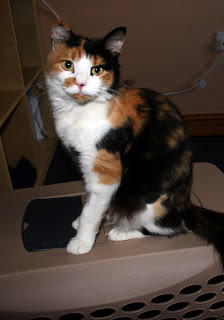
Rudolph was reported to our control centre as an injured stray in the early hours of Thursday morning. He's a very friendly, neutered male who must have been someone's loved pet. He seems to have got away with a nose-bleed and bruising which has left him very unsteady on his back legs although x-rays haven't shown any damage to his spine or pelvis.
As he doesn't need any further vet treatment for the moment, except rest and pain-relief, I've got him back home in a cage lined with vet-bed so that the surgery staff won't need to come in on Christmas day.
As you can see from the photo he's looking quite bright and he's also eating and using his litter tray, but his back legs are still extremely shaky.
“RSPCA
Generated” is the concept that RSPCA branches and centres should give priority to animals "generated" by the work of the Society when setting admissions policies.
This was a huge benefit to branches when it was introduced
because it ended a situation whereby HQ run centres would
preferentially accept very adoptable dogs, which were simply unwanted by
their owners, and branches had to take a higher percentage of
inspectors’ animals (because branches are responsible for
animals taken in buy their local inspector or found as sick/injured strays in their area and HQ centres don't have formal responsibilities of this nature).
Concentrating on the more problematic animals meant higher boarding costs for branches and also made their raw rehoming
statistics appear to show that they were very slow and inefficient at
rehoming compared with HQ centres, because like was not being compared
with like. Injured strays and neglected animals signed over to inspectors will normally take longer before they are fit enough to go to new homes and are also more likely to belong to breeds which are less popular with the general public. Freeing up space at HQ animal centres for animals signed over
for welfare reasons took some of this load off branches.
"RSPCA
Generated" is also morally the right thing because if we have
made a decision to take an animal out of their current situation it is
our responsibility to find a suitable placement.
The downside of this is that sticking to “RSPCA Generated” absolutely
strictly means our branch sometimes has to turn away easily adoptable animals whilst
still being unable to take on the very expensive traffic accident cases.
This probably makes it more difficult to
home the animals we do admit because potential adopters who are attracted by photos of cute kittens may go on to adopt an older cat or dog. Healthy kittens and puppies cost us very
little because they can usually be placed with foster homes and having
them increases interest in and support for the branch.
And please make sure you know how to contact your vet's emergency stand-in over the holiday period. Remember there may be a higher than usual charge because the vet covering has to work when most people are enjoying themselves, so make sure you have enough funds available if an emergency does happen.
Occasionally when you read newspaper accounts of RSPCA prosecutions you'll see that the defendant states that they did seek veterinary help for their animal but couldn't find a vet who would accept people who are on benefits.
People who call our branch helpline sometimes say this and it can occasionally be very difficult to persuade them that they must go to the private vet if their pet is suffering and they are not registered to use the out of hours emergency service attached to our clinic.
Of course the idea that vets are operating some kind of selection process and refusing to add anyone who's not in employment to their client list is nonsense, but I don't think owners who say this are simply making up a story to excuse themselves.
The original conversation with the private vet's reception probably goes something like this:
Animal Owner] My dog's not himself.
Receptionist] Oh dear! Do you want to bring him in today?
Animal Owner] How much will it cost?
Receptionist] £30 for a consultation plus the cost of treatment.
Animal Owner] I'm on benefits; what would I have to pay?
Receptionist] We're a business; we can't give a reduction to people on benefits.
Animal Owner] (puts phone down)
From the point of view of the animal's owner; they would go to a vet if only there was a vet who accepted claimants (by which they mean charging reduced rates).
From the point of view of the vet surgery; they are not failing in their obligation to provide pain relief even if the owner cannot pay because that's not what they've said. They haven't refused to see the animal; they have simply said there won't be a reduction in price.
In October we rehomed 11 cats, one rabbit and nine ferrets.
Our clinic treated 220 dogs, 102 cats, 8 rabbits and 2 hamsters and chipped 14 dogs and 11 cats as well as neutering 8 dogs.
Most of the rabbit visits were for vaccination with the new 12 month vaccine which I hope is a sign that all our educational efforts about the importance of vaccination against myxomatosis is having some effect.
The image of RSPCA Inspectors tends to be of worthy, but rather "establishment" blokes with not a lot of sympathy for those who don't conform.
Chief Inspector John Grant may fit the stereotype if you judge by looks alone, but as a person who was brought up in the traveling community he's better placed than most people to understand the motivations that can lead to over-breeding and welfare problems and search for solutions rather than just nagging about irresponsible behaviour.
Call just now from a relation of someone who's bought two very young puppies and now suspects that one of them has a broken leg as the pup is crying and unwilling to put any weight on it. The actual owner of the pups is on benefits and doesn't even have enough funds for credit on a mobile phone to call me direct.
Dogs are very much more liable than cats to injure themselves by jumping on or off household furniture and unfortunately this kind of thing is a fairly common occurrence. I'm hoping that the leg is simply twisted or bruised and simple pain relief and rest will sort it out. If it really is broken then some kind of operation will almost certainly be needed, although the pup's age is in his favour since growing bones repair themselves much more easily than adult ones.
We may well end up taking in one or both of the pups for rehoming if the owner isn't able to contribute anything towards the cost of treatment because it just isn't fair for us to provide free treatment for owners who haven't made any effort to plan at all, but charge the responsible ones who register their animals and save up to cover the cost of treatment.
Update 10 pm
The owner still hasn't managed to get the puppy to the emergency vet because they don't have any transport or money for a taxi. The puppy seems to be resting reasonably comfortably although he's distressed when he tries to walk. The owner's going to keep trying to locate someone who may be willing to give them a lift.
Update 18th November
Puppy has been seen by a vet and has a probable hairline fracture. He's been prescribed pain relief and cage rest (to give the injury a chance to heal). Owner will have to take him to the RSPCA clinic on Tuesday for a follow-up examination, but fortunately it doesn't look as though a repair operation's going to be needed.
Congratulations to our Newmarket shop team for achieving a fantastic 40% of gift aid sales in October. This represents a lot of hard work behind the scenes as gift aid tax relief can only be claimed if there is a paper trail from donated items to the funds they raise.
This means that our sales team must ensure each donated item is labelled with a bar code sticker matching the sticker placed on the gift aid form completed by the donor. When an item is sold this bar code is scanned at the till and the sale amount credited to the donor number. The till uploads sales details overnight and the computer system keeps a running total of the amount raised by each donor. Periodically I print and mail out the "donor letters" thanking donors and letting them know how much they have raised by their generosity. Once donors have been notified we are able to put in a claim to HMRC for the tax equivalent of the funds raised; meaning that we reclaim 25p for every pound of sales.
That means an extra £500 raised by Newmarket in October—enough to cover the cost of neutering fifteen cats, chipping 70 dogs or providing 150 low-cost consultations at our animal clinic.
Shops, and the volunteers who keep them running, are the life-blood of the branch because they are our only source of regular income which can be increased by working harder.
We need more volunteers to help keep them in action. If you might be able to help, please drop in for a chat or email info@rspca-cambridge.org.uk We also need donations of saleable items and volunteers to help collect donations from people who aren't able to bring them in to the shops.
The RSPCA Council have updated the policy on the role of branches and it's worth reading the document if you might be considering the possibility of joining your local branch committee or volunteering with your local branch as it provides a concise summary of what we're all about. The image below is a bit small - so you may find it easier to read the PDF version.
In fact it's not enormously different from the branch Minimum Animal Welfare Standards which were agreed ten years ago: basically the priorities are to provide help (welfare neutering, microchipping, treatments) to prevent cruelty or neglect and to care for and rehome animals taken in when prevention fails.
To be honest it wasn't a big surprise that my inbox today contained a message from our HQ saying that Tesco are reducing the number of days during RSPCA week 2013 when we can collect donations outside their stores.
RSPCA week has been incredibly valuable to branches over the years, but we've never been able to realise its full potential because we simply don't have enough volunteers to cover all the major Tesco stores over 7 days. Reasonably-enough Tesco now say it's not fair to say no to other charities who might be able to make full use of the opportunity.
The days we can collect will now be Friday May 3rd, Saturday 4th and Sunday May 5th.
If we make a real effort to achieve total cover in 2013, Tesco may revise their decision and offer us the full 7 days again in 2014. If we don't ... we could well see our collection permission reduced even further.
Animal welfare is in crisis. Our inspectors are needed as never before and all the while there is the ticking time-bomb of people who have animals and won't be able to cope if they get ill, or injured, or if the price of feed goes up.
Whether you think the RSPCA is too timid in its campaigns — or much too "activist" — please make a resolution to help us provide the basic welfare services that make animals' lives tolerable.
It would be an enormous help if you could spare just two hours to collect — either during 3-5 May 2013 or during 15-17 February 2013 when we have permission to collect at Pets at Home.
We also need more volunteers to help at our three charity shops and to set up a fundraising group.
Please also consider joining the RSPCA. The more members we have, more likely it is that government will pay attention when we lobby for better treatment of animals. More members also means a larger pool of talent to draw on for local branch committees and stronger democracy.
Harry doesn't have cystitis: he's just looking for a home
Feline cystitis, or to give it its more correct name: Feline lower urinary tract disease (FLUTD) is frightening to owners because any unexplained bleeding is scary.
It can ultimately be a killer in male cats because there is a risk that it will cause what's known as a blocked bladder — when the cat cannot pass urine at all and strains so much that he may rupture his bladder or build up urinary toxins to a point which causes death.
In female cats urinary tract disease is less of an emergency but it should still be treated by a vet as soon as possible.
In both sexes, low-level disease may cause the cat apparently to lose house-training (because he or she comes to associate the litter box with the pain of unproductive straining to pass urine) and cause the owner react harshly and so increase the stress which makes the condition worse.
Today's early morning call from an owner whose female cat was passing small trickles of urine stained with blood was fairly non-worrying (although it would have been better all round if she'd kept up her registration so that she could have seen our out of hours vets today). As she wasn't acutely ill and being female was at low risk of blocking, she could reasonably be asked to wait until our normal clinic session on Tuesday morning.
If she'd been a male with a blockage the story might have been much less happy. Surgical un-blocking can cost up to £600 at a private vet and by the time an owner realises there is a problem a male cat can be in terrible pain, to the point that waiting until our next clinic session would be inhumane.
This caller's cat had been missing for several days and returned on Saturday evening, apparently distressed and panting with her mouth open. She had been to the local private vet in the past, but her owners had no idea that they would be closed over the weekend and that the out of hours cover would cost £100 just for the consultation fee.
They decided to wait until Monday when their normal vet would be available, but by mid-afternoon on Sunday the cat was so visibly distressed that they called the branch helpline in desperation.
I agreed that we would cover the consultation fee so she could have first aid today and they would bring the cat to our Tuesday clinic to register her (with a silent mental reservation on my part that she might not live until then).
Even responsible owners who get their pets vaccinated and chipped and provide routine vet care don't always recognise just how expensive it may be if an emergency happens at an inconvenient time or if a condition doesn't respond to initial treatment and requires several visits to the surgery.
Considering that the recent PDSA survey showed that a third of pet owners aged between 18 and 24 would give their pets up if the cost became too great there's a time bomb of unwanted animals in the making.